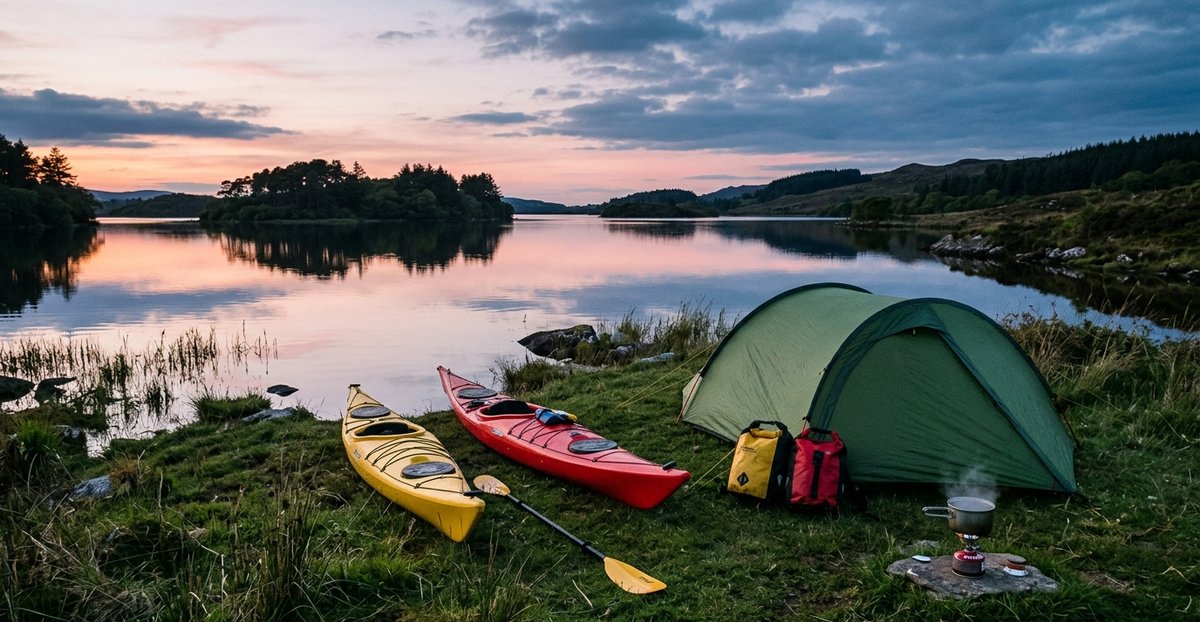
Kayak camping in Ireland is possible, but nobody has a general right to camp. Almost all land is owned, so you either use a campsite or bothy that takes campers, or you ask the owner first. This guide shows who decides, where paddlers can stay overnight in the Republic and Northern Ireland, what it costs and how to plan a safe trip.
We checked each price, season and rule against its own source on 4 October 2026: the operator’s page, the owner’s page or the text of the law. Where a page blocked our checks, we read an archived copy and say so. Northern Ireland operators charge in pounds sterling, so those prices appear as GBP. Convert them at the day’s rate.
This is a guide to what the sources say, not legal advice. If you want places and prices first, skip to the sections on the Republic and Northern Ireland. If you want the rules first, read on.
Your Kayak Camping Options at a Glance
Five options cover almost every overnight paddle in Ireland. The first three come with an owner who has agreed to take you. The last two do not.
| Option | What it takes | Who decides | Suits |
|---|---|---|---|
| Campsite on or near the water | Pay the pitch fee, and book if the site asks | The campsite owner | First trips, groups, a base for day paddles |
| Paddlers’ bothy or campsite on a trail | Book bothies ahead and ask the owner about tent pitches | Share Discovery Village, the National Trust | Lough Erne and Strangford Lough |
| Guided or supported trip | Book with an operator who arranges the nights | The operator | First-timers, river trips, island trips |
| Wild camping with the owner’s permission | Ask first, camp discreetly, leave no trace | The landowner | Experienced, self-reliant paddlers |
| Camping with no permission | You have no agreement to rely on | Nobody has agreed | Not advised |
The next section explains why the last row carries real risk.
Is Wild Camping Legal in Ireland?
Not as a right. This section shows what the official sources say, and where common online claims go wrong.
Is there a right to roam in Ireland?
No. A 2025 guide to property rights and access, produced with Comhairle na Tuaithe and hosted by Sport Ireland, says: “Participants in recreational activities should be aware that there is no legal right of access to the Irish countryside.” People who enter land owned by others for recreation do so “due to the goodwill and tolerance of landowners”. And: “Where a landowner or occupier asks you to leave the land, you should do so.”
Leave No Trace Ireland makes the same point about camping. Its advice is to get permission before you camp. In its section on camping on public land it says: “All land in Ireland is owned, and permission must be acquired before you head on your camping trip.” If you cannot get permission for a site, it says, go to a place where you can camp with permission. We read an archived copy of that page from October 2023, because the live site blocks automated checks.
Waterways Ireland manages the Barrow, the canals and the Shannon. Its Contact us page gives the same advice: “Waterways Ireland does not have an official camping policy. Please seek permission from the landowner, cause no obstruction and follow the Leave No Trace principles.”
You will see claims online that wild camping is “legal in most places” in Ireland. We found no statute or official source that says so, and the official guidance above contradicts it.
What does the law say about camping on private land?
Section 13 of the Criminal Justice (Public Order) Act 1994 is often cited. It covers trespass on a building or its curtilage in a way that causes, or is likely to cause, fear in another person. It is not a general offence of being on someone’s land.
The part of the Act that matters for tents is Part IIA, inserted in 2002. Section 19C bars you from entering and occupying land, or bringing an object onto it, without the owner’s consent where that is “likely to” cause one of several harms. The harms include substantial damage to the land, substantial interference with an amenity, preventing others from making reasonable use of the land, and making it unsanitary or unsafe. The Act’s definition of “object” includes “any temporary dwelling”. The Roads Act 1993 definition it points to begins with “any tent”.
The penalty is a fine of up to €4,000, up to one month in prison, or both. In court, consent is presumed not to have been given until the contrary is shown. A Garda can ask for your name and address and direct you to leave and take your belongings with you.
Whether one night in one place breaks that section depends on the facts, and the courts decide that. What the law does not give you is a right to be there.
What about beaches and the foreshore?
The 2025 access guide says the State owns everything below the ordinary high-water tideline. It adds: “If you are coming from the sea, you can land virtually everywhere below ordinary high-water, but you can’t assume that you have the right to go inland.” Many popular routes to the water cross private land, and access there depends on the owner’s goodwill.
The Foreshore Act 1933 defines the foreshore as “the bed and shore, below the line of high water of ordinary or medium tides”. The Act also provides for licences to place structures on State-owned foreshore, or to “use or occupy” it, for any purpose, and later amendments move the Minister’s consent functions to the Maritime Area Regulatory Authority. We found no official page that says whether a tent on the foreshore needs consent, so we do not claim either way.
Tide matters more than paperwork here. A tent between the tides is a poor idea whatever the law says. Camp above the high-water line, on land where you have permission.
Councils add their own rules. Waterford City and County Council’s 2021 beach bye-laws bar anyone from placing “any tent, caravan, or other temporary dwelling” on a listed beach or the dune system behind it. The list includes Annestown, Bunmahon, Clonea and Tramore. Other councils have their own bye-laws and we have not checked them all, so look up the council before you plan a night on a beach.
Which land managers say what?
Camping rules change with the owner. This table sets out what each source says.
| Land type | What the source says | Source |
|---|---|---|
| Private land, including land beside rivers and lakes and above the high-water line on the coast | No legal right of access. Permission needed from the owner | Sport Ireland access guide, Leave No Trace Ireland |
| Coillte forests | Camping in “selected limited locations only”: two caravan and camping parks (Lough Key and Curragh Chase) and five designated wild camping spots. Individuals may camp one night without a permit only on those designated sites | Coillte FAQs, Coillte permits document, 2026 |
| Killarney National Park | “Camping is not permitted in the Park.” | nationalparks.ie |
| Connemara National Park | Wild camping “only permitted within the more remote parts”. No fires of any kind | nationalparks.ie |
| Glenveagh and Wicklow Mountains National Parks | “Only Wilderness Camping is permitted”, with guidelines to follow | Glenveagh, Wicklow |
| Wild Nephin National Park | Asks overnight campers to register and choose a designated campsite | nationalparks.ie |
| Waterways Ireland land: Grand Canal, Royal Canal, Barrow, Shannon | No official camping policy, so ask. On the canals and the Barrow, bye-law 30 of S.I. 247 of 1988 requires written permission to use a tent as a dwelling on canal property, with an exception for use of up to one week at the same place. The Shannon has its own bye-laws, S.I. 80 of 1992: bye-law 21 bars keeping a tent in the navigation, or using one as a dwelling, for more than one week in any year without permission | Waterways Ireland, S.I. 247 of 1988, S.I. 80 of 1992 |
| Northern Ireland | Public access limited to publicly owned land the public is invited to use, public rights of way, or land where the owner gives permission | NetRegs |
An older Coillte list, from 2017, places the five wild camping spots on walking routes: the Slieve Bloom Way, the Kerry Way, the Avondhu/Blackwater Way and the Western Way in north Mayo. None is described as a paddling stop.
On the Barrow and the canals, Waterways Ireland’s Barrow Navigation page lists S.I. 247 of 1988 as the bye-laws that apply. Bye-law 30 says no person shall “place or use any structure, tent, caravan or vehicle as a dwelling on canal property” without the written permission of “the Commissioners”. It then adds that the rule “shall not apply to persons using canal property for a period of not more than one week at the same place”. Bye-law 38 bars lighting “any fire which might endanger any part of the canal property or cause nuisance to other canal users”. Canal property includes any land the Commissioners own or use.
Waterways Ireland’s 2024 draft keeps the tent clause but names Waterways Ireland as the body that gives permission, and it drops the one-week exception. An Oireachtas committee press release of 13 April 2026 still describes the changes as proposed, and we found no made version. Until one appears, treat Waterways Ireland as the body to ask, and check before you go.
Where Can You Go Kayak Camping in the Republic of Ireland?
These places say on their own pages that they take campers. Most pages do not mention kayaks, so ask before you arrive by water. Prices are as published on 4 October 2026.
River Barrow: Goresbridge to St Mullins
The Barrow has the most organised overnight trips we found in the Republic. Three things make it work: a river that carries you downstream, campsites at set points, and operators who run the shuttle.
Paddle Your Own Canoe, based at Goresbridge, lists a two-day trip from Goresbridge to St Mullins, about 18 to 20 km. It includes a night at The Hub, which the operator calls its “official and exclusive” campsite in Graiguenamanagh, with toilets, showers and changing facilities. The page prices the trip from €100 per adult, plus €7.50 per person at the campsite, and says wild camping options are also available. A child under 16 is from €50. It says the trip runs May to September. The three-day trip runs from Bagenalstown to St Mullins, 29 km in total, from €150 per adult. It uses official campsites at Goresbridge and Graiguenamanagh.
Both package pages list a Canadian canoe for two, a paddle, a buoyancy aid, a helmet and a dry barrel. The operator’s home page also lists single and double sit-on-top kayaks among its equipment. If you want a kayak, ask before you book.
Go With The Flow River Adventures lists a two-day hire over the same stretch from €95, April to October, 21 km. Its route notes split that into about 14.5 km on day one and 6.5 km on day two. You book a canoe or kayak seat, and the hire covers a canoe, paddle, buoyancy jacket, helmet and barrels. Camping equipment is not supplied: “All camping equipment” sits on its list of things to bring. It also lists a three-day hire from Leighlinbridge to St Mullins from €129 per person.
Waterways Ireland’s Graiguenamanagh page names a campsite in the town: “Camp at Graiguenamanagh Camp Site, or stay in one of several local guesthouses.”
Both operators also point to wild camping along the way. Paddle Your Own Canoe says there are “several idyllic wild camping spots” on the route and shares a trail map. Go With The Flow’s notes call Clashganna lock a “nice wild camping spot” with toilets. Those are operator descriptions, not permission from landowners or Waterways Ireland. Locks are part of the canal property that the bye-laws above cover. Ask the operator which spots it uses and whether access is arranged.
Waterways Ireland’s FAQ says no licence or express permission is needed if you are “simply looking to go paddling as an individual”, and that canoes in general must be carried round locks. That covers an individual paddler, so a group or commercial trip should check with Waterways Ireland. Its Special Marine Notice 1 of 2026, dated 3 March 2026, says canoeists must take extreme care near weirs, sluices and locks, that “Shooting weirs is prohibited without permission” and that “Portage is required at unmanned locks”. Carry your boat and kit round locks. For the route itself, see our River Barrow route guide and the Barrow section of the Blueways Ireland guide.
Which lakeside campsites work as a base?
Two lake campsites can work as a base for day paddles. Neither page promises a welcome for kayakers arriving by water, so ask first.
Lough Key Forest and Activity Park in Co. Roscommon has a caravan and camping park open from March to October. A two-person tent is €20 a night, a four-person tent €30 and a six-person tent €35. The park lists P Mac Kayaks as offering “tailor made kayak sessions”. Our Lough Key route guide covers the water.
Lough Allen Adventure at Drumshanbo, Co. Leitrim, has a camping area with 20 electric hook-up spaces and “ample space for camping lakeside”. Its stay page gives no price or season. The neighbouring Allen Centre lists 2026 nightly rates including showers: €25 for a single tent, €30 for a two-person tent, €35 for four and €40 for six (archive copy, April 2026). Neither site says whether kayakers arriving by water are welcome, and we could not confirm that the two pages describe the same camping area, so ask. Waterways Ireland’s paddling page says the Shannon Blueway “holds a network of paddling trails, from the foot of Lough Allen, to beyond the Shannon as far as Lanesborough”. Our Shannon Blueway route guide covers the water.
On Lough Derg, Waterways Ireland’s Scarriff page lists put-in and take-out points for paddlers, toilets, showers and fresh water taps, with B&Bs for an overnight stay. We found no official Lough Derg Blueway page that names a paddlers’ campsite.
Which Atlantic islands take campers?
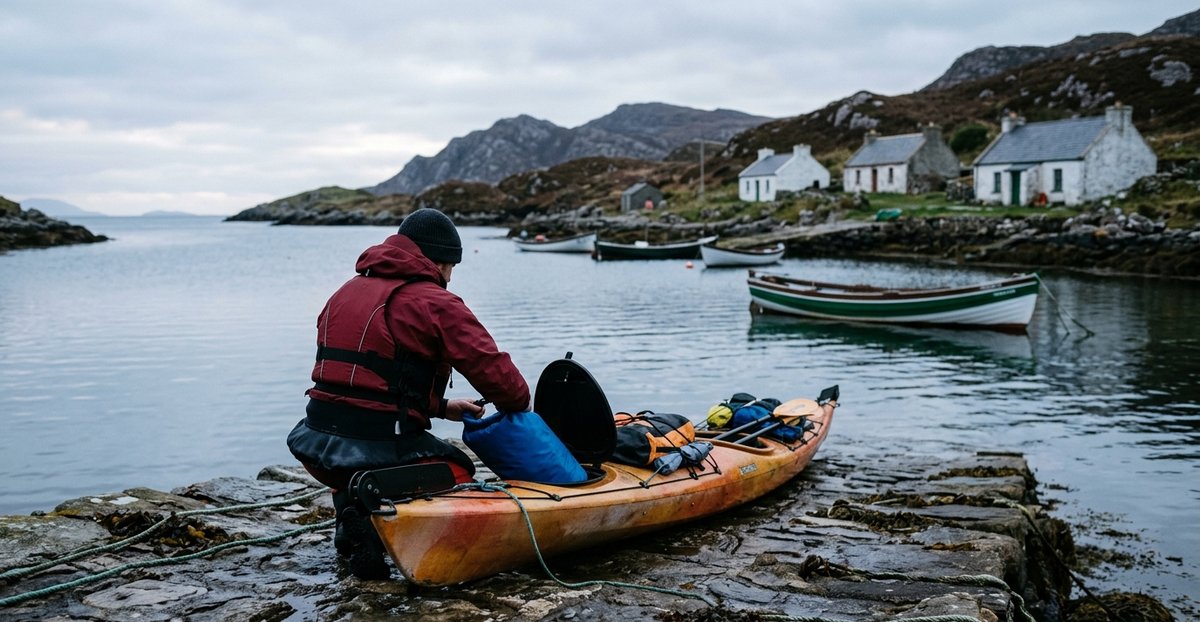
Sea kayakers like islands, and several islands have a campsite. These are the pages we found. None describes a landing place for kayaks, apart from the Clare Island campsite being “close to the pier, the beach, the community centre” and RUA Camping on Inis Oírr being “a short walk from the Island’s pier and airstrip”. Ask the campsite or the island community where kayaks land and where to leave them.
| Island | What the page says | Season and cost |
|---|---|---|
| Clare Island, Co. Mayo | Community campsite with a drinking water tap, toilets and coin-operated showers. Spaces are not reserved | €10 per person per night. Under 12s free |
| Inis Oírr, Aran Islands | RUA Camping offers tent pitches and bell tents | Not stated on the home page |
| Inis Mór, Aran Islands | Aran Island Ferries lists “Aran Islands Camping and Glamping” | Not stated for the campsite. The page says most Inis Mór accommodation is available March to October |
| Inishbofin, Co. Galway | Hostel and campsite: “Limited camping available”, 700 metres from the ferry | Open April to October |
| Great Blasket, Co. Kerry | Blasket Island Ferries runs a ferry for people wild camping on the island | Same fare as a day trip. 2026 season closed until 6 May 2027 |
| Great Saltee, Co. Wexford | “No camping is allowed on the islands at anytime.” | Not available |
| Inishkea Islands, Co. Mayo | “No wild camping is allowed on either of the Inishkea Islands as the island is privately owned.” Permission from the landowner is needed | Not available |
The Blasket ferry page does not say who gives permission to camp, and it covers ferry passengers, not paddlers arriving under their own power. The Clare Island campsite also offers a charcoal BBQ on a €50 deposit, and asks campers to bring their own charcoal. For the mainland side of these crossings, see our guides to Clew Bay and the Connemara coast.
What does a sea kayak guidebook say about island overnights?
Oileáin, by David Walsh, is a guide to the Irish islands for sea kayakers. Canoeing Ireland’s sea kayaking guides page credits its guides “courtesy of David Walsh and Oileain”. The author’s recommended excursions page gives a suggested number of nights for each trip. It says camping and water availability is “a common need” on two-day, three-day or longer excursions. The author calls the list his “personal choice of the 50 best excursions”. The grades are his own, out of five stars.
| Excursion | Quality | Difficulty | Nights | Author’s comment |
|---|---|---|---|---|
| Aran Islands | 5 | 3 | 1 to 3 | “Take as much time over this as possible.” |
| Clare Island | 4 | 2 | 1 | “Less remote and a bit easier of access.” |
| Galway west-facing coast, outer islands | 5 | 3 | 2 to 3 | Cruagh, High Island, Inishbofin and Inishturk |
| West-facing Galway and Mayo | 5 | 4 | 5 | “Clifden to Belmullet without touching the mainland.” |
| Achill, round of | 5 | 5 | 3 | “Overnight at Doogort, Keel and Achillbeg.” |
| Tory | 5 | 5 | 1 to 2 | “Linger a couple of days.” |
| The Blaskets | 5 | 3 | 0 to 2 | “The best.” |
| Roaringwater Bay, inner section | 5 | 2 | 0 to 3 | A group of paddlers “might flourish for days” |
| Saltees | 3 | 2 | 0 to 1 | “Lovely overnight, but watch the tides on the Bridges.” |
A guidebook suggestion is not permission. Oileáin’s list suggests 0 to 1 nights on the Saltees and calls it a “Lovely overnight”. The islands’ owners say no camping is allowed on the islands at any time. The Inishkea Islands show the same gap between a well-known destination and the owners’ rules. Treat the owner’s rule as the one that counts, and check with the owner or the island community before you plan a night.
The author adds a warning that applies to every row: “The quality of what you get needs to be set off against the difficulty attaining it.” His Rockabill entry says to avoid April and May for landing, a reminder that seabird colonies set their own calendar.
Are there guided kayak camping trips in Ireland?
Guided trips can take the planning off your hands. Neither operator’s page says who gave permission for its camping grounds, so ask (the questions are below).
Shearwater Sea Kayaking, based at Howth, lists five kayak-and-camp trips: Kingdom of Kerry, Connemara islands, Inishkea Islands, Donegal islands and West Cork. Its Inishkea page says “These trips are not for beginners” and that they suit Level 2 or 3 sea kayakers. That page currently shows no upcoming dates and says weekend trips are scheduled a few days ahead, depending on the weather. Email the operator before you plan around any of its trips.
Sea Kayak Ulster lists a Donegal Cliffs and Islands expedition on 10 to 14 July 2027, a “basecamp expedition with camping included” on the Wild Atlantic Way. It describes its trips as “designed for paddlers with some paddling experience”. The page shows no price.
Ask any operator four things before you book. Who owns the camping ground, and has the owner agreed? Which dates are actually running? What do the kit, food and transfers in the price cover? What insurance applies? The last one matters, because cover differs between operators. Go With The Flow’s hire page, for example, says it does not provide insurance, so a hire company’s terms are not a trip operator’s terms.
For single-day hire and tours, see our kayak rental guide. For island trips on the west coast, our West Cork, Mayo and Donegal guides cover the water.
Kayak Camping in Northern Ireland: Lough Erne and Strangford Lough
Northern Ireland publishes more paddler-specific camping information than we found anywhere in the Republic, through Outdoor Recreation NI’s canoe trails. The land rules still apply. NetRegs says public access is limited to “areas of land which are in public ownership and to which the public are invited to use”, public rights of way, or places “where the public have the landowner’s permission to visit”. Safety bodies in Northern Ireland are UK ones, HM Coastguard and the Met Office. Our Northern Ireland guide covers that.
What do the official Lough Erne pages say about camping?
Outdoor Recreation NI lists the Lough Erne Canoe Trail at 42.2 miles, about 68 km. It says access to the water is free and no licence is required. It describes the islands and quiet shores as suited to wild camping. Waterways Ireland’s paddling page says: “You can make a real adventure of it by wild camping on the shores and islands.”
Neither sentence names a site or an owner. The trail’s own code of conduct asks for care. The trail guide, a 2012 edition and the latest we could find, says to “Gain permission before accessing private property” and that “Wild camping should be carried out discreetly, in small parties, and for overnight stays only.”
Outdoor Recreation NI’s live Lough Erne trail page says the islands and quiet shores are “ideal for wild camping” but no longer carries a campsite list. The old camping page for the trail, archived in October 2024, lists official campsites at Edgewater Holiday Park, Castle Archdale Caravan and Camping Site, Share Discovery Village and Rushin House Caravan Park, with Crom Estate. It also lists rough camping places at Bellanaleck, Belleek Marina, Carrybridge (east side), Castle Island, Cottage Lawn, Derryad Quay, Inish Davar (island), Knockninny Quay, Muckross, Rossigh, Smiths Strand, Trory and the Trannish Island Bothy. Inish Davar is booked through Castle Archdale Country Park. The page says: “Do not light fires at any of the camp sites unless permission has been granted by the land owner.”
Crom is the entry to ignore. The National Trust has removed the Crom campsite from its holidays portfolio. A statement reported by the Fermanagh Herald in April 2026 says: “the decision has been made to remove the Crom Campsite from the National Trust holidays portfolio and we’re currently considering options locally.” We found no announcement of a replacement for paddlers. The Trust’s Crom visitor page, in a July 2026 archive copy, still advertises camping pods, so ask the Trust what is open. The list is two years old, so confirm any other site with its owner. Our Lough Erne route guide covers the paddling.
How do the Trannish Island Bothy and the Share campsites work?
Share Discovery Village owns a small part of Trannish Island on Upper Lough Erne and runs a bothy there. Its page calls the bothy a stop on the Lough Erne Canoe Trail. It lists 100 GBP for exclusive use of the bothy plus a refundable 100 GBP deposit, and 6 GBP per person per night for the campsite (18 GBP for a 3 man tent). It adds that Share cannot promise exclusive use of the campsite or island. Booking the bothy does not include the fenced camping area or exclusive use of the showers and toilets.
The rules on the page are specific. If you book the bothy, arrive after 3pm and leave by midday the next day. The island is only part owned by Share and often has livestock, so close all gates and keep out of the fields and any buildings outside the bothy grounds. The landing is a shallow channel with no pontoon. Small boats are hauled up onto the beach and tied down. Book through Share’s camping page or by email.
Share’s main campsite runs from Easter to the end of September, from 20 GBP a night for a one or two person tent, with a minimum of one night. The same page also says the family campsite is open from April to October, so confirm the dates before an autumn trip. Tent check-in is 12.30pm and pitches are vacated by 11.30am. Share says tent pitches are first come, first served and cannot be reserved. The page bans campfires and fire pits on site. Check with Share before you plan to arrive by water.
Can you stay on Salt Island, Strangford Lough?
Salt Island sits just south of Killyleagh and belongs to the National Trust. The Strangford and Lecale AONB’s Salt Island page says the bothy was restored in June 2008 and “sleeps approximatley 8 persons”. The sleeping platforms are movable, with no mattresses or bedding. There is a wood-burning stove and a kitchen area with a sink but no cooker. The bothy has no mains water, so bring drinking water. Salt Island is one of 11 canoe access points on the Strangford Lough Canoe Trail. Bookings go through the National Trust at Mount Stewart.
The National Trust’s Strangford Lough canoeing page says: “Salt Island Bothy is open and available for bookings.” We read that on a June 2026 archive copy, because the live page blocks automated checks. An archived Trust page from October 2021 said the bothy was not accepting bookings for the foreseeable future. The Strangford and Lecale AONB’s Salt Island page says bookings go through the National Trust at Mount Stewart on 028 4278 8387, so ring to confirm the status before you build a trip around it. We found no official page that says whether camping, as opposed to the bothy, is allowed on Salt Island or the shore.
Landing needs a tide check. The AONB page says the area in front of the bothy “becomes mud flats at low tide which has the potential to strand boats until the tide returns”. The beach in the north-west bay is reachable at all states of tide and is a few minutes’ walk from the bothy.
Wildlife limits apply across the lough. The Trust says: “We do not encourage visitors to land on islands used by seals for haul outs, by breeding seabirds or where there are grazing cattle.” Outdoor Recreation NI says some islands become breeding grounds, and “access is not permitted to certain islands at these times”. Our Strangford Lough guide and route page have more on the water.
On the Lower Bann, Waterways Ireland says the canoe trail suits independent travellers who “paddle, camp, or stay in local B&Bs along the river”. Outdoor Recreation NI’s current Lower Bann trail page lists no campsites. Its old camping page, archived in December 2024, listed Portna and Movanagher as free sites with about 20 tent pitches each and advance booking, and Drumaheglis Marina as a paid site with eight tent pitches. We could not confirm any of these with the owners, so ring ahead.
Which Sea Kayak Skills Do You Need for a Camping Trip?
No Irish award certifies a paddler for overnight trips as such. We read the Canoeing Ireland sea kayak award pages for Levels 2 to 5. None uses the words “overnight”, “multi-day”, “expedition” or “camp”. The Level 5 page is the only one that mentions planning “extended or remote trips”.
What the awards do give you is a published set of conditions for each level. This table comes from Canoeing Ireland’s conditions pages, dated 6 February 2026.
| Level | Wind | Sea state | Tidal flow | Distance and open crossings |
|---|---|---|---|---|
| Level 2, Peer Award | Force 0 to 2 | Smooth, 0.1 to 0.5 m | No tide races, overfalls, surf or swell | No more than 1 nautical mile from an exit point in case of emergency. Open crossings not applicable |
| Level 3, Explorer Award | Force 0 to 3 | Slight, 0.5 to 1.25 m | Tidal streams and overfalls under 2 knots | Within 1 nautical mile of shore. Open crossings not applicable |
| Level 4, Adventure Award | Force 0 to 4 | Moderate, 1.25 to 2.5 m | Overfalls, tidal streams and tide races ≥ 3 knots | Open crossings up to 4 nautical miles, shore to shore |
| Level 5, Horizon Award | Force 0 to 5 | Moderate, 1.25 to 2.5 m | Overfalls, tidal streams and tide races ≥ 3 knots | Open crossings where the destination is out of sight |
An island crossing is an open crossing. Match the trip to the least experienced person in the group, and choose the level of the water, not the level of the best paddler.
Level 5 shows what Canoeing Ireland expects before a paddler plans extended trips. Candidates need a Level 4 Adventure Award or equivalent, a VHF Short Range Certificate, the Canoeing Ireland Advanced Navigation Certificate or equivalent, an in-date Remote Emergency Care Level 3 first aid award or similar, and a minimum age of 18. They also complete a two and a half day course. If you do not hold those skills yet, book a guided trip or join a club.
River trips set a lower bar. Paddle Your Own Canoe’s page says “No Experience Needed” and that first-time paddlers are welcome. Operators carry the kit and run the shuttle, which is why we suggest a river trip as a first overnight. Our beginners guide covers the basics.
How to Plan a Multi-Day Kayak Camping Trip
How do you plan the route and the days?
Pick the water first. A river like the Barrow carries you downstream, with a shuttle at each end and campsites at fixed points. A lough trail like Lough Erne gives you islands and shelter, but wide water that the wind can stir. The Atlantic islands bring the biggest crossings. Oileáin’s author puts the best sea kayaking on the west side, saying “the best kayaking in Ireland is in the remoter areas, which broadly means the outside half, the west side of the island”.
Then build each day around the camp, not the distance. Go With The Flow’s two-day Barrow trip splits 21 km into about 14.5 km and 6.5 km, with a night in Graiguenamanagh. That gives you time to pitch, cook and rest. Write a bad-weather option for every day. The Department of Transport’s Code of Practice asks sea kayakers to have “a passage plan and alternative emergency plans, e.g. safe landing area down wind”.
Do not go alone. Canoeing Ireland’s safety page says: “It is not advisable to go out alone, it is much safer to go out in groups of 3 or more.” The Code of Practice puts it more shortly: “Do not operate alone – kayak in company.”
What safety kit and paperwork do you need?
Start with the law. Regulation 6(1) of S.I. 921 of 2005 says a person on a pleasure craft under 7 metres “shall wear a suitable personal flotation device while on board an open craft or while on the deck of decked craft”, other than when the craft is made fast to the shore or at anchor. The Code of Practice chapter for kayaks says wearing a PFD is “a legal requirement” and that the term includes a buoyancy aid.
The rest is guidance, but it is the Department of Transport’s guidance. The Code of Practice says for sea kayaking:
- Communications. VHF is “the recommended method of communication”. Mobile phones “should not be relied on and should only be considered as a back up means of communication”.
- PLB. While sea kayaking, “you should carry a registered personal locator beacon (PLB)”. ComReg registers PLBs, not the Coast Guard, and accepts only beacons programmed with the Irish country code, 250. It passes the details to the Irish Coast Guard.
- Navigation. Carry a chart and a compass.
- Extra kit to consider. Flares, a towrope or throw bag, a torch, a suitable knife, a portable waterproof VHF radio, a portable GPS unit, a PLB, a first aid kit, spare food and drink, a paddle float and leash, and sun protection.
- Where to keep it. Essential equipment goes on the person and the rest in “an easily recoverable buoyant grab bag”.
- If you capsize. “Remain with” your boat, which “offers a better target to rescuers”.
On radios, the Department of Transport says a Ships Radio Licence applies to “all vessels, irrespective of size, with marine radio transmitting equipment onboard”. The Code’s appendix says the licence covers handheld radios. For pleasure vessels with VHF and DSC, the qualification is the Radio Operators Short Range Certificate. The official pages do not name kayaks, so confirm with the Department before you rely on a handheld.
Tell someone your plan. The Code gives a shore contact template and a passage planning template in Appendix 8, with fields for route, distance and time, forecast, tides, contingency plans and safe places of refuge. It recommends logging a Traffic Report with the nearest Coast Guard Radio Station, by VHF (Channel 16 or a Coast Guard working channel) or by phoning a Coast Guard Rescue Co-ordination Centre. The Code says there is no charge for the service. Close the report when you finish.
A Traffic Report is not a float plan. The Code says: “The Irish Coast Guard will not initiate overdue procedures based on Traffic Report messages.” It adds that failing to close the report will not start a search, so your shore contact must raise the alarm if you do not return as planned. In an emergency, “raise the alarm on VHF Channel 16 or call 999 or 112 and ask for the Coast Guard”.
How do you read the forecast and the tides?
Met Éireann’s Sea Area Forecast covers Irish coastal waters out to 30 nautical miles. Met Éireann’s terminology page says it is issued four times a day, at midnight, 6am, noon and 6pm, with any Small Craft Warnings. The live forecast page on 4 October 2026 showed a 24-hour validity window and a Small Craft Warning status. For river trips, the Code says to consult Waterways Ireland’s marine notices and lockkeepers, and the same notices are worth checking on any lough the authority manages.
Know your limits against the wind. The Code says: “Canoeing in a windforce 4 or above should only be considered for the very experienced.” Canoeing Ireland’s Level 3 conditions stop at Force 3. Our sea kayaking guide explains how wind and tide combine on Irish coasts.
For tides, the Marine Institute’s tidal predictions page lets you create predictions for a six-day period up to two years ahead. Oileáin’s site links to Met Éireann’s marine forecasts and to Irish Sailing Club tide times for Dublin, Galway, Cork and Belfast. Check the tide at your landing as well as your launch. Salt Island’s mud flats are the example: a bothy shore that strands boats at low water.
What goes in each bag?
Build the pack list from the safety kit above, then add the camp. Go With The Flow’s own list adds a repair kit that includes “duct tape and multi tool (at a minimum)”.
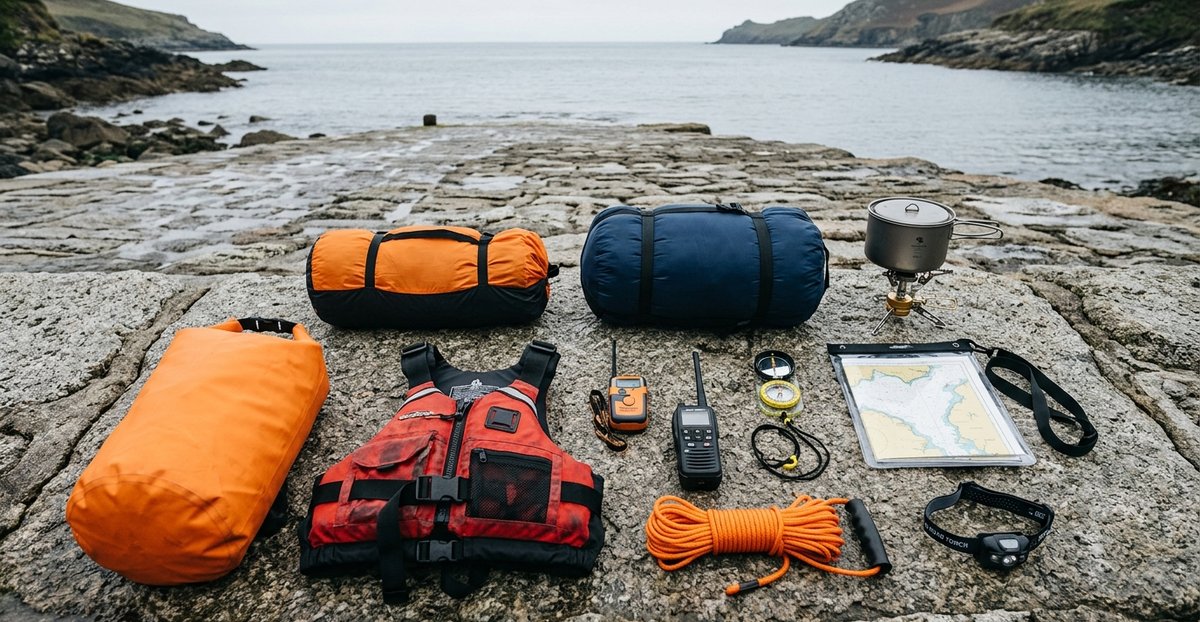
| Group | What to pack | Notes |
|---|---|---|
| On your body | PFD with whistle, VHF or PLB, knife | The Code says essential kit goes on the person |
| Deck and cockpit | Chart in a waterproof case, compass, paddle float, towline | Within reach after a capsize |
| Shelter and sleep | Tent, sleeping bag, sleeping mat | Pack each in its own dry bag |
| Cooking | Stove, fuel, pot, lighter, food | Bring a stove. Many sites ban fires |
| Water | Drinking water for the trip, plus a way to treat more | See the water section below |
| Clothing | Warm layers, a spare dry set, a rain jacket | Our sea kayaking guide covers what to wear |
| Repairs and extras | Head torch, first aid kit, repair kit, sun protection | Duct tape and a multi tool at minimum |
Keep heavy items low and near the middle of the boat. The Code asks you to make sure the boat is not overloaded when you carry extra kit. A touring kayak with sealed bulkheads gives room for camping kit, and our kayak buyer’s guide explains the choice.
How do you keep water and kit clean?
Moving between waters spreads species. The Check, Clean, Dry campaign, launched by Leave No Trace Ireland, the National Biodiversity Data Centre and partners, tells you to “DRY all equipment and clothing for at least 48 hours”, and to disinfect everything if complete drying is not possible. The notice does not say how to disinfect, so check the campaign’s own guidance for the method. Read the campaign notice from Inland Fisheries Ireland before a trip that crosses several waters.
Fresh water carries health risks. The Health Protection Surveillance Centre lists people whose outdoor pursuits, such as canoeing, put them in contact with at-risk water among those at greatest risk of leptospirosis. It says high-risk water includes “stagnant, dirty-looking or obviously polluted fresh water” and that sea water poses less risk. Its precautions include covering cuts with a waterproof dressing, showering after water activities and washing your hands before eating.
Drinking untreated water carries risk too. The HPSC’s cryptosporidiosis factsheet lists “Backpackers, hikers, and campers who drink unfiltered, untreated water” among those at risk. We found no Irish official guidance on treating wild water, so carry your drinking water or treat what you collect. The Salt Island bothy has no mains water, which is why its page says to bring your own.
Fire, Wildlife and Leave No Trace
Can you light a campfire?
Often you cannot. The rules come from owners, bye-laws and statute.
- National parks. Connemara says it does not allow “fires of any kind”. An NPWS notice of 24 June 2026, issued during an Orange Forest Fire Warning, is headed “Reminder – There is a complete Ban on fires or BBQs in National Parks”. It appeals to everyone “not to light fires or BBQs in public places”, including national parks, nature reserves and coastal sand dunes.
- Campsites and islands. Share bans campfires and fire pits. The Saltee Islands owners say the lighting of fires is “strictly forbidden”. Outdoor Recreation NI’s Lough Erne camping page (the October 2024 archive copy) says not to light fires at its camp sites unless the landowner gives permission.
- Canals. Bye-law 38 of S.I. 247 of 1988 bars lighting any fire that might endanger canal property or cause a nuisance to other canal users.
- The Wildlife Act. Section 40 makes it an offence “to cut, grub, burn or otherwise destroy”, between 1 March and 31 August, any vegetation on land not then cultivated. Its exemptions do not cover burning. Section 39 also bars lighting a fire likely to burn vegetation within one mile (about 1.6 km) of a wood that is not yours.
These two sections target fires that burn vegetation. Landowner rules, park rules and bye-laws still apply wherever you camp, so bring a stove. The Department of Agriculture’s wildfire advice adds: “Do not light fires in or near woodland. You will be responsible if fire spreads from a campfire or barbeque.”
How do you avoid disturbing seals and seabirds?
Islands are where seals and seabirds breed, and the dates matter. NPWS says grey seals “generally breed in Irish Waters from September to December on remote and generally undisturbed areas, in particular offshore islands”. Its common seal page says common seals come ashore in June to give birth, and in July and August to moult.
The law backs this up. The Wildlife Act 1976 lists “Seal species” among protected animals. Section 23 makes it an offence to wilfully interfere with or destroy the breeding place or resting place of a protected wild animal. Section 22 makes it an offence to wilfully disturb a protected wild bird “on or near a nest containing eggs or unflown young”.
We found no official minimum approach distance for kayaks near seals from NPWS, the Marine Institute or the Irish Whale and Dolphin Group. Do not rely on distances quoted from other countries. Follow the guidance that does exist. Canoeing Ireland’s access code says: “Avoid wildlife during sensitive times: mating, nesting, raising young, or winter.” The National Trust does not encourage landings on islands used by seals or breeding seabirds, and Outdoor Recreation NI warns that some Strangford islands close in breeding season.
What does Leave No Trace mean for a kayak camper?
On a paddling trip it comes down to permission, discretion and care. Permission comes first, which is why Leave No Trace Ireland leads with it. Then follow the paddler code in Outdoor Recreation NI’s Lough Erne trail guide, a 2012 edition. It asks you to “Minimise your impact on the natural environment and use recognised access points”, to be sensitive to wildlife and to the noise you make, and to “Observe wildlife from a distance and be aware of sensitive locations such as nesting birds and wintering flocks”. It also says: “Wild camping should be carried out discreetly, in small parties, and for overnight stays only.”
Share’s rules for Trannish Island add practical detail. Close the gates. Keep out of the fields and out of any building that is not part of the bothy grounds. Expect livestock on the island. Haul small boats up the beach and tie them down. If you book the bothy, arrive after 3pm and leave by midday so the next group can use it.
Leave the site as you found it. The Clare Island campsite asks BBQ users to leave the BBQ as they found it, and checks it before it refunds the €50 deposit. The next paddler needs the owner’s goodwill as much as you do.
What Does Kayak Camping Cost in Ireland?
Prices below are as published on 4 October 2026, in the currency the operator uses.
| What | Price as published | Notes |
|---|---|---|
| Barrow two-day trip, Paddle Your Own Canoe | From €100 per adult. From €50 for a child under 16 | Plus €7.50 per person at The Hub campsite. May to September |
| Barrow three-day trip, Paddle Your Own Canoe | From €150 per adult. From €75 for a child under 16 | Bagenalstown to St Mullins, 29 km |
| Barrow two-day hire, Go With The Flow | From €95 | Camping equipment not supplied. April to October |
| Barrow three-day hire, Go With The Flow | From €129 per person | Leighlinbridge to St Mullins |
| Clare Island campsite | €10 per person per night | Under 12s free. No reservations |
| Lough Key campsite, two-person tent | €20 per night | Four-person tent €30, six-person €35. March to October |
| Share Discovery Village campsite | From 20 GBP per night | Easter to end of September. No campfires |
| Trannish Island campsite | 6 GBP per person per night | Bothy: 100 GBP exclusive use plus a refundable 100 GBP deposit |
| Salt Island Bothy | Not published on the pages we checked | Book through the National Trust |
| Great Blasket wild camping ferry | Same fare as a day trip | 2026 season closed until 6 May 2027 |
Some costs sit outside the pitch fee. Go With The Flow says a taxi back is “not included, prebooking advised”. It also says: “We do not provide any form of insurance with our canoe hire service.” Ask any operator what insurance covers, and arrange your own cover if it does not. An optional River Barrow guidebook is €25 on the same page.
When to Go Kayak Camping in Ireland
Most organised options run from spring to autumn. Wildlife and fire rules add their own dates.
| When | What changes | Source |
|---|---|---|
| 1 March to 31 August | Offence to burn vegetation on uncultivated land | Wildlife Act 1976, section 40 |
| March to October | Lough Key campsite open. Most Aran Islands accommodation open | Lough Key, Aran Island Ferries |
| April to October | Inishbofin hostel and campsite open. Go With The Flow Barrow hire available | Inishbofin directory, Go With The Flow |
| Easter to end of September | Share Discovery Village camping season | Share Discovery Village |
| May to September | Paddle Your Own Canoe two-day trips | Paddle Your Own Canoe |
| Spring and summer | Some Strangford islands closed to access for bird breeding. The trail page gives no dates, so ask the National Trust warden | Outdoor Recreation NI |
| June | Common seals come ashore to give birth. They moult in July and August | NPWS |
| September to December | Grey seals breed, mostly on remote offshore islands | NPWS |
| Until 6 May 2027 | Blasket Island Ferries season closed | Blasket Island Ferries |
Check opening dates every season. An archived National Trust page from 2021 shows the Salt Island bothy closed to bookings then, a June 2026 archive copy of the Trust’s canoeing page says it is open, and the Trust has removed the Crom campsite from its holidays portfolio.
Common Mistakes on a First Kayak Camping Trip
- Trusting “legal in most places”. No statute or official source we found says it. Sport Ireland’s access guide says there is no legal right of access.
- Trusting an old guidebook overnight. Oileáin’s recommended excursions suggest 0 to 1 nights on the Saltees. The owners say no camping at any time. Ask the owner.
- Treating a Traffic Report as a float plan. The Coast Guard does not start overdue procedures from one. Your shore contact must raise the alarm.
- Relying on a phone. The Code recommends VHF and says sea kayakers should carry a registered PLB. It says mobile phones “should not be relied on” and should only be a back-up.
- Landing at low tide without a check. Salt Island’s bothy shore turns to mud flats and can strand boats until the tide returns.
- Lighting a fire. Many sites ban fires, and the law restricts burning vegetation. Bring a stove.
- Camping on a bird or seal island in breeding season. The dates in the table above are the ones to avoid.
- Skipping Check, Clean, Dry between waters. Dry kit for at least 48 hours, or disinfect it.
- Packing for the forecast, not the margin. Plan a spare day and a bad-weather option for every leg.
Frequently Asked Questions
Is wild camping legal in Ireland? There is no legal right of access to the Irish countryside, according to a 2025 guide produced with Comhairle na Tuaithe. Leave No Trace Ireland says permission must be acquired before you camp. Use a designated site or ask the landowner. Entering and occupying land, or leaving an object on it, without the owner’s consent is an offence under section 19C of the 1994 Act where it is likely to substantially damage the land or an amenity, stop others making reasonable use of it, make it unsanitary or unsafe, or otherwise substantially interfere with it.
Can you kayak anywhere in Ireland? Not everywhere. Canoeing Ireland’s summary of the law says that where one landowner owns the land on both banks, that owner also owns the river bed and “can prevent trespass on a river the same as if somebody was walking across their land”. On the coast, the 2025 access guide says you can land virtually everywhere below ordinary high water but cannot assume a right to go inland. Ask before you launch from private land.
Can you camp on the Killarney lakes? Not inside Killarney National Park. nationalparks.ie says: “Camping is not permitted in the Park.” It also says overnight camping is not permitted in the Ross Castle car parks or the large car park near Muckross School House. Land outside the park still needs the owner’s permission. Our Killarney Lakes guide covers day paddles.
Do you need a permit to kayak on the Barrow or the canals? Waterways Ireland says that if you are “simply looking to go paddling as an individual”, no licence or express permission is required. That statement covers an individual paddler. If you run a club or business trip, ask Waterways Ireland. The canal bye-laws on tents and fires on canal property still apply.
Which kayak is best for camping? A sea kayak with sealed hatches carries the most, and our buyer’s guide explains the choice. The Code of Practice says open canoes are not suitable for the sea, and that inflatable kayaks are not suitable for sea kayaking. On the Barrow, operators supply sit-on-top kayaks and dry barrels.
Can beginners try kayak camping? Yes, on the right water. Barrow operators sell trips to first-timers. Paddle Your Own Canoe’s page says no experience is needed and lists its trips for children aged 7 and over. Sea trips are different. Sea Kayak Ulster designs its expeditions for paddlers “with some paddling experience”.
Can you drink water from lakes and rivers? The Health Protection Surveillance Centre lists campers who drink unfiltered, untreated water among people at risk of cryptosporidiosis. We found no Irish official guidance on treating wild water, so carry water or treat what you collect.
Also Read
- Sea Kayaking Ireland: The Complete Guide — conditions, gear and what to wear for sea trips.
- Blueways Ireland — Every Paddling Trail Mapped — the Barrow, Shannon and Erne trails in detail.
- Kayaking Safety in Ireland: Essential Tips & Rules — the safety basics before any trip.
- Kayaking Northern Ireland: Causeway Coast & Strangford — the wider guide to paddling in the North.
- Best Kayak for Irish Waters: Buyer’s Guide — choosing a boat that carries camping kit.

No comments yet on this guide.
Be the first to share your experience — conditions, access, hazards, or anything a future paddler should know.
Login to join the discussion