Limerick offers one of the most varied kayaking experiences in Ireland, from urban paddling through a medieval city centre to tranquil inland loughs and a tidal estuary shaped by the ESB’s hydro scheme upstream. The River Shannon is the county’s lifeline, running from calm water above Castleconnell down through fast tidal currents beneath the city’s bridges and out into the open Atlantic.
This guide covers every part of that picture: the best launch spots in the county, the hydrology that actually governs how fast the water moves, the real cost of a guided tour, the clubs you can join, and what to do if something goes wrong. Every figure below is sourced to a named operator, club or authority — where we could not confirm a number, we say so rather than guess.
1. Why Limerick Is a Paddling Hub
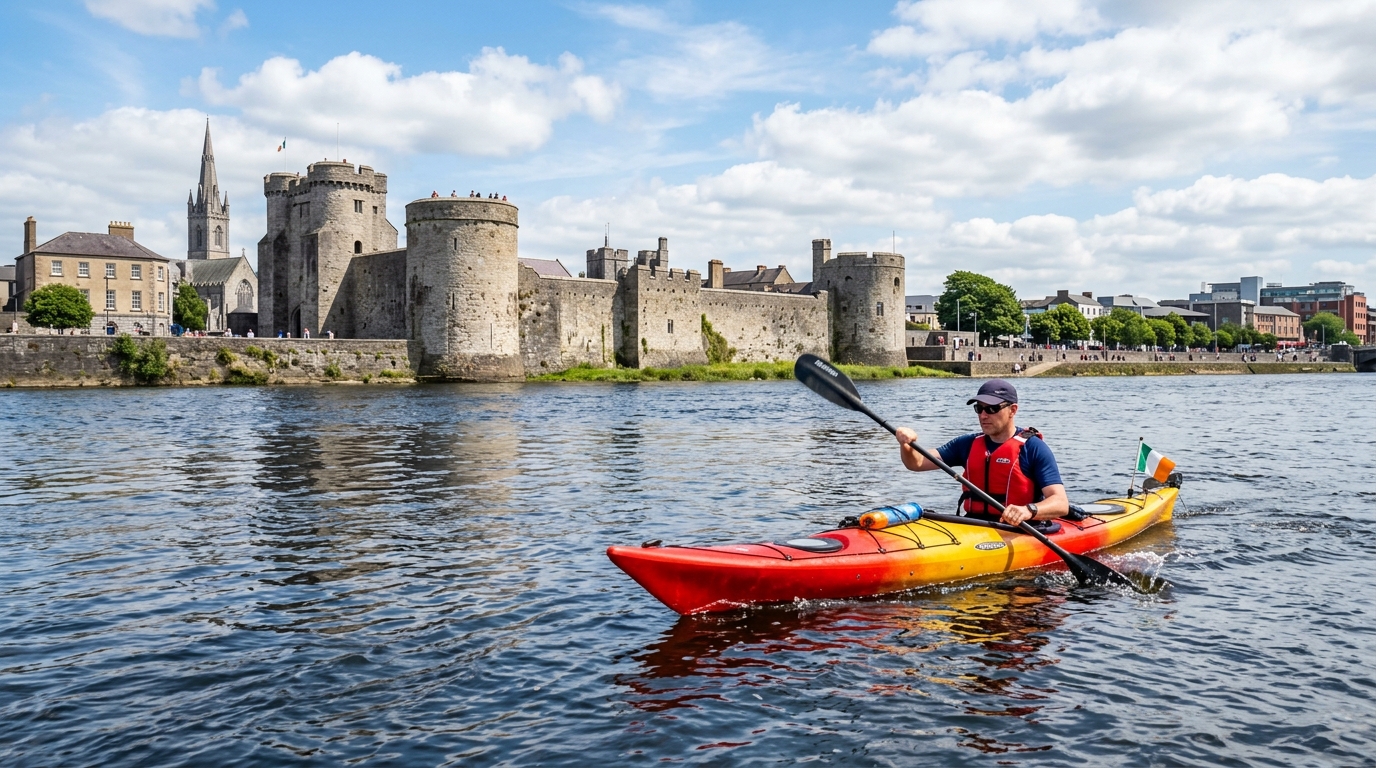
When people picture kayaking in Ireland, they usually picture the Wild Atlantic Way — sea caves in Cork, cliffs in Kerry. Limerick’s advantage is different, and it’s a big one: the River Shannon, Ireland’s longest river, meets the tidal Atlantic right at the edge of the city.
That meeting point creates a genuinely dynamic paddling environment inside a fifteen-minute drive. You can paddle a calm, non-tidal stretch above Castleconnell in the morning, then drop into the city centre in the afternoon and find fast-moving tidal water that challenges experienced paddlers. Few Irish counties offer that range without a long drive between locations.
Beyond the river, Limerick is dotted with sheltered inland loughs cut off from coastal wind and swell. The city itself adds a layer few other Irish paddling destinations have: real medieval history on the water. The Vikings established a permanent settlement on King’s Island around 922, and King John’s Castle — the stone fortress that dominates the city stretch today — was built on the orders of King John from roughly 1200, largely complete by 1210. Excavations at the site during the 1990s turned up remains of that earlier Viking settlement, including houses, underneath the castle grounds. Few Irish kayaking routes let you paddle past a thousand years of continuous history on a single afternoon.
Compare that to Cork or Kerry, where the paddling is almost entirely coastal, and Limerick’s real point of difference becomes clearer: it’s the only county on this list where a single county boundary contains a working hydroelectric scheme, a tidal city centre, a beginner countryside river, and an open Atlantic estuary, all within about half an hour’s drive of each other. That’s not a claim any single coastal county can make in the same way.
2. Who Should Paddle Here?
Limerick’s waterways cover every skill level in Canoeing Ireland’s scheme, provided you pick the right location for your ability.
- Beginners (Level 1–2): Lough Gur suits novice paddlers and families in sit-on-top kayaks. The River Shannon above Castleconnell can be gentle at normal water levels, but flow there is governed by ESB releases from Parteen Weir (see section 4), so check conditions before treating it as automatically beginner-friendly.
- Intermediate (Level 3): The guided city tours through Limerick City suit fit beginners paddling with a guide, or intermediate paddlers who can read fast-moving water and eddy lines on their own.
- Advanced (Level 4+): The lower Shannon Estuary towards Foynes and the open Atlantic coast brings serious tidal exposure and wind fetch, and calls for a proper touring or sea kayak, full safety gear, and real sea kayaking experience.
Two local clubs also shape who paddles here and how they get started — Limerick Kayak & Canoe Club and the University of Limerick Kayak Club, both covered in section 10.
Families with younger children are best served by Lough Gur or a guided city tour rather than any of the river stretches above Castleconnell, since none of those upstream sections should be treated as predictable enough for a first-time paddler without an instructor alongside them. A group with mixed experience — say, two confident paddlers and two beginners — generally does better splitting between a guided city tour and a Lough Gur session on separate days than trying to force everyone onto the same stretch of water.
3. When to Go: Weather and Water Conditions
Timing a paddle in Limerick comes down to three things: the season, the tide, and how cold the water actually is.
Season and Tide
Between November and March, the Shannon carries a large volume of floodwater down from the centre of the country, and the flow through Limerick City picks up noticeably — paddling the city stretch in winter calls for strong current-reading skills, tidal planning, and cold-water gear. Conditions tend to be calmer between May and September, when river flow is generally lower and air temperatures are milder, though this depends on rainfall in any given year and is never something you can bank on without checking a forecast first.
Season aside, the stretch of the Shannon running through Limerick City is fully tidal, and that matters more, day to day, than the time of year does. At Limerick Dock, the tidal range runs up to roughly 5.4–5.5 metres on the biggest spring tides — this is a river that rises and falls by metres, twice a day, not a gentle lake. Because the exact times and heights shift daily, don’t rely on a number you read once: check a live tide table for Limerick Dock before you launch, every time.
The currents around Thomond Bridge and Sarsfield Bridge get genuinely powerful, especially on an ebbing tide combined with river flow heading the same direction — a winter flood tide ebbing hard is the single worst combination this stretch produces, which is exactly why the seasonal flow pattern above and the daily tide state need to be checked together, not separately. Always check the Met Éireann marine forecast and current tide tables before launching. If wind exceeds Force 3, the wider parts of the river and the estuary chop up and get difficult for less experienced paddlers.
| Beaufort Force | Wind Speed (knots) | River/Lake State | Recommendation for Limerick Paddlers |
|---|---|---|---|
| Force 1–2 | 1–6 knots | Calm, glassy | Usually manageable on Lough Gur and the upper Shannon, but still check tide state and forecast on the tidal stretch. |
| Force 3 | 7–10 knots | Gentle breeze, ripples | City tours can often still run. Sit-on-tops need more effort, and wind against tide can raise chop even at this force. |
| Force 4 | 11–16 knots | Moderate breeze, chop | Shannon Estuary becomes rough. Only for paddlers with the skill, gear and experience for exposed, tidal water. |
| Force 5+ | 17+ knots | Fresh breeze, whitecaps | Stay ashore. Wind, fetch, tide and current can combine to make any of these locations dangerous at once. |
How Cold Is the Shannon, Really?
Cold water is the risk nobody asks about until they’re in it. General marine climate data for the Shannon area puts the annual average water temperature around 12°C, dropping to roughly 8.5–9.5°C in February and March and climbing to around 16–16.5°C in August. Out in the estuary itself, where Atlantic water mixes in, the range widens — winter surface temperatures closer to 4–6°C, summer closer to 15–18°C. Treat these as approximate seasonal ranges from general regional data, not a precise daily reading; if you want an exact figure on the day, check Met Éireann’s own sea temperature data before you go. Either way, the practical takeaway is the same: the water here is cold enough, year-round, that a wetsuit or drysuit is worth having rather than optional. As a rough guide, a 3/2mm or 4/3mm wetsuit covers most of the year on the river stretches, but anyone paddling the estuary or the city stretch in winter should think in terms of a drysuit rather than a wetsuit, since prolonged immersion at those temperatures is a real risk, not a theoretical one.
4. Understanding the Shannon Hydro Scheme
Most of what makes the Castleconnell stretch and the city centre behave the way they do traces back to one structure a few kilometres upstream: Parteen Weir.
What Does Parteen Weir Actually Do?
Parteen Weir splits the Shannon’s flow into two paths. The larger share — up to roughly 400 cumecs — is diverted down the 13-kilometre Ardnacrusha headrace canal to the ESB’s hydroelectric power station. Only a much smaller compensation flow, roughly the first 10 cumecs, continues down the river’s original course through O’Briensbridge and Castleconnell. That water rejoins the main river via the Ardnacrusha tailrace near Corbally, just upstream of the city. Ardnacrusha itself dates from 1929, one of the largest hydroelectric schemes in the world when it opened, and still runs three original Francis turbines from that year alongside a fourth Kaplan unit added in 1934 — a working piece of 1920s engineering, not a modern addition, which is part of why its releases follow operational logic rather than anything a paddler can predict from the bank. This split is what local paddlers actually mean when they talk about “ESB releases” affecting Castleconnell — when the ESB adjusts how much water it sends down the headrace canal versus the old riverbed, the level on the Castleconnell/O’Briensbridge stretch changes accordingly, sometimes quickly.
What Do the ESB and Waterways Ireland Say About Paddling This Stretch?
Waterways Ireland’s own published boater guidance for the Shannon Navigation, sourced from the ESB, is specific: do not travel the stretch between Ardnacrusha and Limerick city when more than one power station turbine is running, because the velocity increase through that section becomes genuinely dangerous for small craft. That warning matters more than it might sound, because Ardnacrusha’s generating station runs four turbines — three original Francis units dating from 1929, plus a fourth Kaplan unit added in 1934 — with a combined installed capacity of around 86 megawatts, so having more than one turbine running is a routine operating state at a working power station, not a rare edge case you can assume won’t apply to you. The guidance also flags that flow increases after heavy rain, and recommends checking Marine Notices before travelling to Ardnacrusha at all. Before you go, Waterways Ireland’s boater-info page for the Shannon Navigation lists direct lock-keeper contact numbers so you can check what the station is doing that day rather than guessing from the bank. Numbers on public pages change occasionally, so treat any figure you find as a starting point and confirm it against the live page immediately before you travel, rather than relying on a number saved from a previous trip. This is real, current operational guidance, not general caution — treat it as a checklist item alongside the tide table, not an optional extra.
5. The Best Places to Kayak in Limerick
Here are seven real locations in and around County Limerick, from historic city loops to quiet rural rivers, ranging from complete beginner water to advanced whitewater.
1. Limerick City (River Shannon Loop)
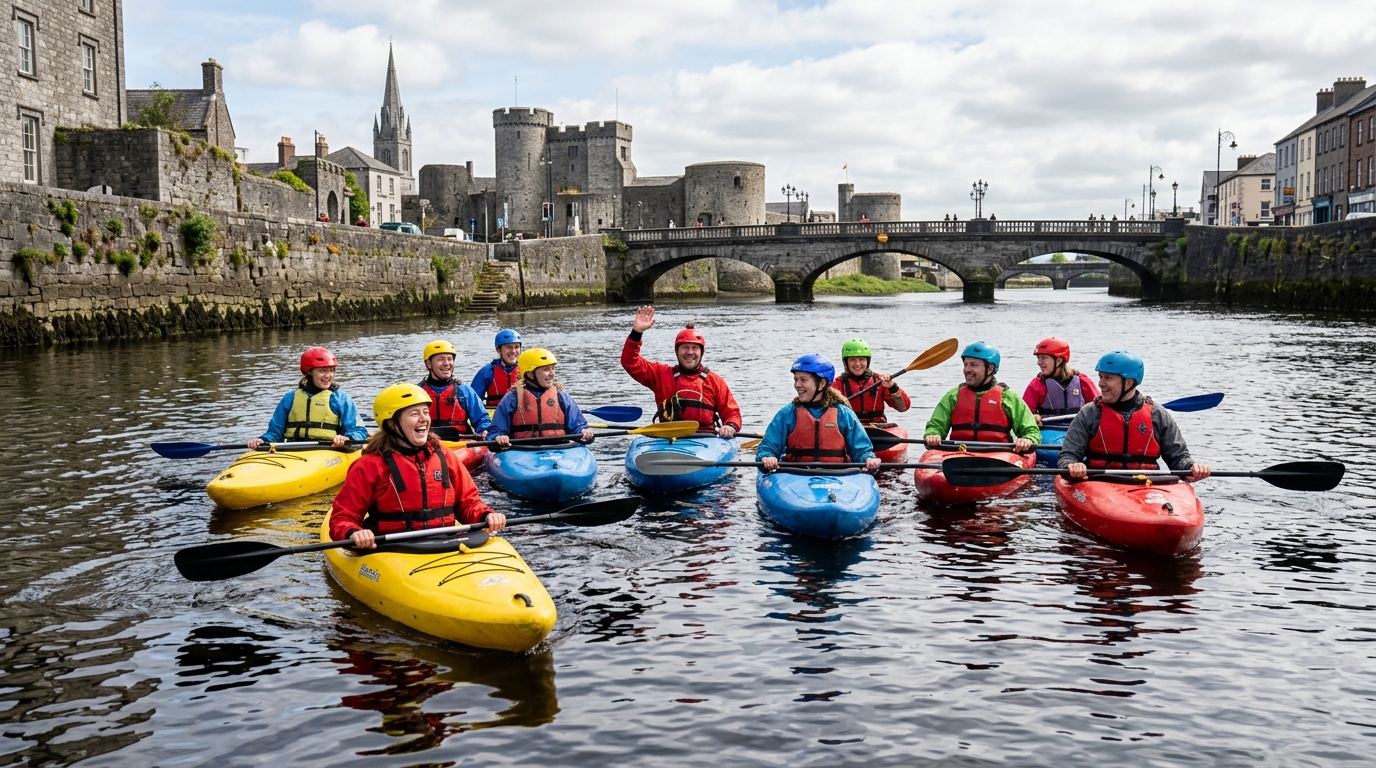
Kayaking through Limerick City is arguably the best way to see it. The Shannon runs straight through the urban centre, and the contrast between the natural power of the river and the stone embankments either side is striking. Most paddlers launch from the slipway near the Hunt Museum — itself worth a visit before or after your paddle, since it holds one of Ireland’s more significant private art and antiquities collections in a former customs house right on the riverbank — then paddle downriver towards the stone walls of King John’s Castle and the Treaty Stone.
Right beside the castle, Curragower Falls is a Grade 2 rapid where the Shannon drops over a rock ledge — and unlike the impression you might get from the Parteen/Ardnacrusha flow-split further upstream, it isn’t governed by the tide alone. Irish Whitewater’s own guide to the feature is specific: the wave works roughly from September to April, running for about three hours around each low tide and at its best from roughly two hours before low water, but it also needs the ESB to be releasing somewhere in the region of 100 to 400 cumecs down the Ardnacrusha headrace at the time — too little water off Parteen Weir and the wave simply doesn’t form, tide state or not. Treat Curragower the same way this guide treats Castleconnell in section 4: check both the tide table and the day’s ESB release before you rely on it behaving a particular way. The Abbey River branches off around King’s Island but carries its own weirs and isn’t a simple loop for independent paddlers to circumnavigate.
- Skill Level: Intermediate, or beginner with a guide.
- Vibe: Historic, urban, fast-moving.
2. Lough Gur
If the tidal Shannon sounds too much, Lough Gur is a calmer alternative about 20 km south of the city. This horseshoe-shaped lake is one of Ireland’s most important archaeological sites, ringed by drumlin hills, stone circles, and the ruins of a shoreline castle. With no tidal flow to manage, it suits beginners, families and sit-on-top kayaks far more readily than the city stretch — though wind can still raise chop on open water, so it isn’t without any risk at all.
Kayaking on the lake currently runs through the Kilfinane Outdoor Education Centre’s guided sessions — contact the centre directly for current age limits, booking lead time, and whether any seasonal or event-linked sessions are running when you plan to visit, since none of that could be independently confirmed against their live page in this pass. If you’re hoping to launch independently rather than through a guided session, confirm access and any permission needed with Lough Gur’s own management first — we could not find a published rule either way, so don’t assume either answer.
- Skill Level: Beginner.
- Vibe: Peaceful, sheltered, ancient.
3. Castleconnell to O’Briensbridge
Just north of the city, the Shannon offers a well-known stretch between Castleconnell (Co. Limerick) and O’Briensbridge (Co. Clare) — a favourite among local clubs, but not a gentle novice run by default. Whitewater guides grade it from Grade 2 at normal levels up to Grade 4 in flood, because it acts as the spillway channel below Parteen Weir (see section 4). Levels can rise quickly when the ESB sends more flow down this course rather than the Ardnacrusha headrace, so check current river conditions before you go rather than assuming it’s beginner water. At normal levels the scenery is heavily wooded and quiet, a real contrast to the city a few kilometres downstream, and it’s a good spot for kingfishers and otters. A popular put-in sits near the village of Castleconnell itself, with the run finishing at a take-out on the Clare bank at O’Briensbridge — short and close enough to the city that many local paddlers treat it as an after-work session rather than a full day out, conditions allowing.
- Skill Level: Intermediate to advanced, depending on water level — check flow before paddling.
- Vibe: Nature-focused river touring at normal levels; whitewater in flood.
4. Lough Derg Blueway at Killaloe/Ballina
Immediately upstream of Castleconnell, where the Shannon widens into Lough Derg, sits a genuinely useful facility for paddlers that the county’s other spots don’t have: proper infrastructure. Waterways Ireland manages a 160-km network of shoreline paddling trails around Lough Derg, with 21 marked paddling routes and put-in and take-out points at Killaloe/Ballina that come with car parking, toilets, showers and fresh water taps. For a Limerick-based paddler, this is a far more locally relevant blueway than the generic term suggests — it sits right at the top of the stretch you’d otherwise drive to Castleconnell for, with facilities the riverside launch points further down don’t offer. The lake also stays paddleable through the winter months, since it has no tidal cycle to plan around, though the open water can still chop up quickly in a strong westerly.
Read more on our dedicated Lough Derg route guide for put-in details and route options along the lake.
- Skill Level: Beginner to intermediate, depending on chosen route and open-water exposure.
- Vibe: Sheltered lake paddling with real facilities on shore.
5. River Maigue at Adare
A genuinely under-used beginner river close to the city: the Maigue flows through Croom and Adare on its way to the Shannon Estuary, and whitewater guides describe it as well suited to less experienced paddlers, with twelve weirs broken up by short flat sections between them. None of it is fast water in the way Curragower or Castleconnell can be — the challenge here is managing each weir individually, not reading a strong current.
According to Irish Whitewater’s river guide for the Maigue, the put-in is off the N21 heading from Limerick towards Adare: take the first exit at the roundabout after the dual carriageway ends, continue for roughly 5 km, and after a sharp left-then-right bend, turn right at a signpost for a restaurant. The take-out is at the N21 bridge into Adare, beside the ruins of an old monastery. It’s a genuinely different day out from the tidal city stretch — flat, historic, and close enough to combine with a walk around Adare’s own medieval village afterwards. Scout each weir from the bank before running it, and be ready to portage any that don’t look clean.
- Skill Level: Beginner, with weirs to manage — scout each one before running it.
- Vibe: Quiet countryside river, historic village at the finish.
6. Foynes and the Shannon Estuary
As the Shannon widens past Limerick City, it becomes a broad estuary that feels more like open sea than a river. Launching near Foynes gives access to Foynes Island and expansive tidal mudflats. This stretch is heavily exposed to Atlantic wind funnelling up the estuary and needs a proper sea kayak and real coastal navigation skills.
The Shannon Estuary is home to Ireland’s only known resident bottlenose dolphin population — an estimated 140 to 145 individuals, monitored by the Shannon Dolphin and Wildlife Foundation from its base in Kilrush, Co. Clare. Worth knowing honestly, though: Kilrush and Carrigaholt, much further downriver towards the open Atlantic, are the real centre of that population’s range. Foynes sits well upriver of it, so a sighting there is a genuine possibility, not something to plan a trip around.
Foynes itself has an aviation history most paddlers don’t expect on the Shannon: it was the eastern terminus for transatlantic flying boats in the late 1930s and early 1940s, before Shannon Airport took over that role, and the village is generally credited as the birthplace of Irish coffee. None of that changes the paddling conditions, but it’s worth building into the day if you’re driving out that far for an advanced estuary paddle.
Read more on our Shannon Estuary route guide before attempting this stretch.
- Skill Level: Advanced.
- Vibe: Expansive, coastal, exposed.
7. The Mulcair River
For whitewater paddlers, the Mulcair (also spelled Mulkear) offers seasonal excitement after heavy rain. The well-known section, often called the Newport run, is a 3-km Grade 2–3 stretch that’s actually listed in Co. Tipperary rather than Limerick, running down to the village of Newport. It’s a scrape at low water and needs a decent level to be worth paddling; published guides also flag overhanging-tree and pinning hazards throughout, so it calls for whitewater training, a proper helmet, and a river-running kayak rather than a touring boat. Some of those same guides go further and flag barbed wire strung low across the water in places, along with undercut rocks that can trap a paddler rather than just a boat — reasons enough to treat this as a scout-before-you-run stretch even for paddlers used to Grade 3 water elsewhere. Levels drop noticeably in summer — the river stays an active year-round fishery even then, it just runs lower — so it paddles best after autumn and winter rain.
- Skill Level: Advanced whitewater.
- Vibe: Fast, technical, seasonal.
6. How to Execute a Limerick City Paddle
If you’re planning to paddle the Limerick City loop without a commercial guide, plan carefully.
- Check the tide and the flow together. Tide state alone won’t tell you what the river is doing. A rising tide or slack water is often more forgiving than a strong ebb, but upstream flow — including how the ESB is running Parteen Weir that day — can override that (see section 4). Check both the tide table and current river conditions before committing to a launch time, and don’t treat either source on its own as the full picture.
- Pick your launch point. Use the public slipway near the Hunt Museum, or the rowing clubs near O’Callaghan Strand. Both give reasonably direct access to the main channel without crossing the busiest boat traffic. Park legally and securely, and don’t leave valuables visible in the car — this is a city centre, not a rural car park.
- Stick to the main channel. Follow the Shannon past King John’s Castle and the Treaty Stone unless you know the Abbey River’s weirs and currents well. Watch for Curragower Falls near the castle, which changes character with both the tide and the ESB’s release off Parteen Weir, so check both before assuming it will look the same as the last time you paddled past.
- Mind your bridge etiquette. Approaching bridges like Thomond Bridge, look for the arches with the least turbulent water, usually the widest or most central span. Avoid the bridge piers themselves, where the current forms strong eddies and unpredictable swirls that can catch a hull side-on.
- Know where you’d exit in an emergency. Before you launch, identify at least one realistic landing point along your planned route where you could get out safely if conditions change or someone in your group gets into trouble. On the city stretch, that usually means a stone slipway or set of steps rather than the embankment itself, which is often too high or too sheer to climb out of a kayak.
7. What Can Go Wrong: Risks on the Shannon
The core risk in Limerick is underestimating how much power the Shannon carries, especially on the tidal city stretch.
Bridge Pillars and Weirs
Water accelerating around the stone pillars of Limerick’s bridges creates strong currents that can pin a kayak against the stone or flip an unwary paddler — Thomond Bridge and Sarsfield Bridge are the two worth watching most closely, since both sit close to the tightest bends on the tidal city stretch (see section 3). Curragower Falls, right beside King John’s Castle, is a hazard with two variables rather than one: it works roughly from September to April, running for about three hours around each low tide and at its best from roughly two hours before low water, but it also needs the ESB releasing somewhere around 100 to 400 cumecs off Parteen Weir at the time — so the safe window to run it, or avoid it, shifts with both the tide table and that day’s release, not with the tide alone (see section 5). The natural weirs on the Castleconnell stretch are different again, shaped by how much water the ESB is sending down the old riverbed versus the Ardnacrusha headrace canal at Parteen Weir — the same stretch can be a gentle Grade 2 one week and a pushy Grade 4 the next, with nothing visible from the bank to warn you the level has changed (see section 4 for the full turbine and lock-keeper guidance). Know exactly where these features sit on your planned route before you launch, and portage — carry your kayak around — any weir or bridge pier you’re not confident running, rather than trying to read it from the water on the day.
- Urban debris underfoot. In the city centre, the riverbed can hold shopping trolleys, glass and other debris from decades of use as a working urban waterway. Never walk barefoot in the water or wade through a shallow section, and treat any cut from broken glass or metal as a reason to get out and clean the wound properly rather than carrying on with the paddle.
What to Do If Something Goes Wrong
If you or someone in your group gets into difficulty, call 999 or 112 (free from any phone) and ask for the Coast Guard. If you’re carrying a VHF radio, use Channel 16 and state your location clearly. When you call, give the Coast Guard your exact location, how many people are in your group, and what’s happened — that’s what decides whether a lifeboat, a helicopter or a shore-based team gets tasked. The nearest RNLI inland lifeboat to this stretch of the Shannon is Lough Derg Lifeboat Station at Dromineer — Ireland’s first RNLI inland station, operational since 2004 — which currently runs a B-class Atlantic 85, on station since 2019. Dromineer’s crew covers the length of Lough Derg and can reach as far as Killaloe and the top of the Castleconnell stretch within a reasonable window, though the city centre and the estuary below it fall outside that lifeboat’s usual range, which is exactly why knowing to call 999/112 matters more than knowing any single station’s location. In June 2013, the station carried out two separate call-outs within 24 hours, including the rescue of 22 schoolchildren from a Cub Scout troop kayaking on Lough Derg. It’s worth knowing that resource exists before you need it, not after.
8. What to Avoid: Common Mistakes
If you’re visiting Limerick to paddle, avoid these common mistakes.
- Paddling the city stretch solo. Unless you’re a highly experienced local paddler who knows the tidal quirks intimately, don’t paddle the city stretch alone. The combination of fast current and capsize risk calls for a group.
- Ignoring the estuary mud. If you paddle near Foynes or the lower estuary, avoid landing on mudflats at low tide. The mud runs deep and sticky, and it’s easy to get stuck up to your waist in it. Stick to stone slipways or gravel beaches instead.
- Using a cheap inflatable. A discount supermarket inflatable has no place on the tidal Shannon — the current dictates where you go, and you’ll have little control over it. Use a proper rigid kayak or a high-pressure drop-stitch model.
- Treating the PFD as optional. Under Irish law — the Pleasure Craft (Personal Flotation Devices and Operation) (Safety) Regulations 2005, S.I. No. 921/2005, Regulation 6(1) — a PFD must be worn, not just carried, on any open craft under seven metres, and every kayak falls into that category. This isn’t a style recommendation; it’s the law.
- Assuming the Castleconnell stretch is always calm. Because it’s fed by a compensation flow off Parteen Weir rather than the main river channel, its character can change with ESB operations rather than the weather alone. Check current conditions, not just the forecast.
9. Financial Breakdown: Tour and Hire Costs
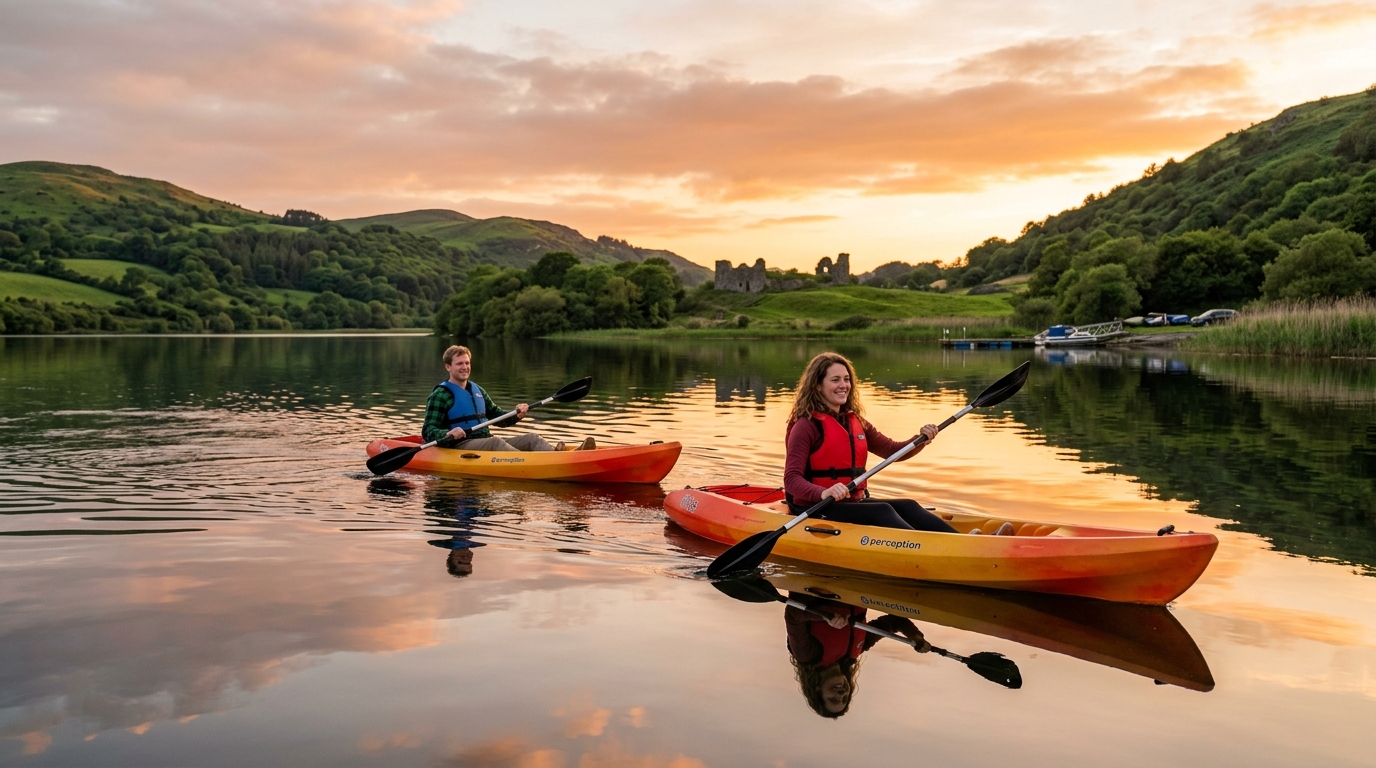
If you don’t have your own kayak, or you want the safety of a local guide, Limerick has solid options. Nevsail Watersports is the main operator for kayaking in Limerick City, running out of the Hunt Museum and blending kayaking instruction with local history and Viking lore. Their current listed products include the Limerick City tour, a night kayak tour, a Clare-to-Limerick paddle, a Kilkee Bay trip, kayaking at Bunratty Castle, Level 1 and 2 courses, and standalone kayak hire.
| Product | Operator | Price |
|---|---|---|
| Limerick City kayak tour, 1.5hr, adult | Nevsail Watersports | No fixed public price — booking runs through a FareHarbor widget, and third-party listings for the same tour disagree by roughly €25–€50. Check Nevsail’s live booking page before you book. |
| Lough Gur kayaking session | Kilfinane Outdoor Education Centre | Not published online — contact the centre directly to confirm the current price before booking. |
Booking a guided tour is a sensible choice for your first time on the city stretch. Guides provide the gear — wetsuits, buoyancy aids, helmets — which also saves you hauling wet kit through the city afterwards. For Lough Gur, factor in that Kilfinane OEC’s sessions are booked at least a week ahead, so this isn’t a spontaneous, turn-up-and-go outing.
If you already own a kayak, launching independently at a public slipway costs nothing beyond fuel and parking, though you take on the tide, flow and hydro-scheme planning yourself rather than handing it to a guide. If you’re still deciding what to paddle in, our buyer’s guide to the best kayak for Irish waters covers the difference between a sit-on-top and a touring hull in exactly the kind of mixed conditions Limerick throws at you.
10. What Comes Next: Training and Clubs
If your paddle past King John’s Castle makes you want to take the sport more seriously, Limerick has two genuinely different clubs worth knowing about, depending on who you are.
Limerick Kayak & Canoe Club
The county’s main community club runs weekly trips every Sunday on the Shannon, the Maigue, the Mulkeir, the Deal and the Clare Glens — a real spread that covers most of the locations in this guide. It’s worth being clear about the entry bar, though: membership expects Canoeing Ireland Level 2 skills or higher, so it isn’t an open walk-in-and-paddle path for absolute beginners. A typical Sunday sees members meet at an agreed put-in, car-share out to that week’s chosen river, and paddle as a group rather than solo, with more experienced members informally keeping an eye on anyone newer to a particular stretch. The easiest way in is to email the club directly, describe your current experience level honestly, and ask to come along as a guest before committing to full membership. The club runs a junior section from March to October, and organises annual trips further afield, including to Wales, the French Alps, Norway and Slovenia. You can reach the club by phone on +353 86 3661946 (evenings only), by email at limerickkayakclub@gmail.com, or through limerickkayakclub.wordpress.com.
University of Limerick Kayak Club
A separate, entirely different entity aimed at students: UL Kayak Club takes on new members every year, most with little or no prior kayaking experience. It runs pool sessions on Tuesday, Wednesday and Thursday evenings at 21:45, and competes at events including ICUPs, Galway Fest and the Kayak Intervarsities, where it has a strong track record according to the university’s own club listing. Pool sessions focus on the fundamentals — wet exits, bracing, and basic boat control in a controlled, heated environment — before the club moves newer members on to moving water later in the year. Membership is priced the way most university sports club memberships are, as an annual fee set through UL’s clubs and societies structure rather than a per-session charge, so check the club’s own page for the current figure rather than relying on a number here. If you’re a student in the city or just starting out and want a genuinely beginner-friendly route in, this club — reachable via its Facebook page, @ulkayak — is built for exactly that, in a way the community club’s Level 2 entry bar isn’t.
Either club is a better route to real skills progression than teaching yourself from the bank: expert coaching, a fleet of club boats, and the safety of paddling with a group who know the river.
Beyond a club, our guide to Kayaking for Beginners in Ireland covers how to start from zero, and our Kayak Clubs in Ireland directory lists more options across the country if Limerick’s two clubs don’t fit your schedule.
7 Frequently Asked Questions
Is kayaking in Limerick City safe for beginners? It’s manageable for beginners, but only with a guided tour operator like Nevsail. The tidal currents on the Shannon change too much, too fast, for an absolute beginner to read alone. With a guide, it’s a well-supervised, genuinely enjoyable way to see the city.
Do I need my own wetsuit to kayak in Limerick? If you’re booking a tour, the operator provides one. If you’re paddling your own boat, a wetsuit or drysuit is worth having — general marine data puts the Shannon area’s water temperature at roughly 8.5–9.5°C in late winter and around 16°C at its August peak, cold enough year-round that cotton and swimwear aren’t a serious option. Check with your club or guide on what they specifically require.
Do I have to wear a lifejacket while kayaking in Limerick? Yes. Under the Pleasure Craft (Personal Flotation Devices and Operation) (Safety) Regulations 2005 (S.I. No. 921/2005, Regulation 6(1)), a PFD must be worn — not just carried in the boat — on any open craft under seven metres, which covers every kayak on the Shannon.
Can I use a sit-on-top kayak on the River Shannon? On Lough Gur, yes. On the Castleconnell stretch it depends on the water level and flow that day, since this section can run anywhere from Grade 2 to Grade 4. In the tidal city stretch, sit-on-tops can be used under a guide’s supervision, but a touring kayak handles the current far more efficiently.
What happens if I get into trouble on the water? Call 999 or 112 and ask for the Coast Guard, or use VHF Channel 16 if you’re carrying a radio and state your location. The nearest RNLI lifeboat covering this part of the Shannon system is based at Dromineer on Lough Derg.
Are there changing facilities at the launch spots? Commercial tour operators provide changing areas. If you’re launching independently at public slipways like the Hunt Museum, or at Lough Gur, there are no dedicated public changing rooms. Most local paddlers use a changing robe by their car.
Do I need a permit to paddle on Lough Gur? Kayaking on the lake currently runs through guided sessions with the Kilfinane Outdoor Education Centre, which need to be booked at least a week ahead. If you want to launch independently, confirm access and any permission needed with Lough Gur’s own management before you go, and respect the wildlife and archaeological sites around the shore either way.

No comments yet on this guide.
Be the first to share your experience — conditions, access, hazards, or anything a future paddler should know.
Login to join the discussion