Hiring a kayak in Dublin is one of those quietly underrated city activities. For somewhere between twenty euro and fifty euro a session you can paddle past the Ha’penny Bridge on a guided tour, around a Georgian-era basin in Dublin 4, along a tree-lined canal headed west out of the city, or out into a sheltered sea bay forty minutes north of the M50. None of it requires owning a boat, joining a club, or knowing what you are doing in advance. A briefing, a buoyancy aid, and somewhere between thirty minutes and a full day of paddling are bundled into the price, and you walk away with a different mental map of the city than the one you arrived with.
This guide covers kayak rental and rental-style kayaking sessions in Dublin city, the wider Dublin region and the immediate north-Dublin coast, checked directly against each operator’s own current website in September 2026. Genuine unguided self-paddle hire has become rare in Dublin — most operators now run fixed-time supervised sessions or guided tours instead, and we have flagged that explicitly wherever a self-paddle option is not actually available, so you do not show up to a quay expecting to walk away with a boat for an hour.
If you are not yet sure whether rental is the right call versus a guided tour or a beginner lesson, jump straight to the rental versus guided tour versus lesson section further down. If you know what you want and you are price-shopping, skip to the where to rent at a glance table that opens the next section.
Where to Rent in Dublin at a Glance
Genuine self-paddle kayak rental has all but disappeared from the Dublin region. Of the five operators covered here, only Portobello Adventure has ever advertised true walk-away hourly hire, and its current operating status can’t be confirmed. City Kayaking, Surfdock, Kayaking.ie and Skerries Watersports each now run a fixed-time guided or supervised session in its place. Pricing is per-session except where flagged.
| Operator | Launch | Water | Product | Price | Season | Online booking |
|---|---|---|---|---|---|---|
| City Kayaking | Liffey Boardwalk, D1 | Tidal river | Guided tour only (no self-paddle hire) | €49 adult / €45 child, 2-hr tour | Apr–Oct | Yes |
| Surfdock Watersports | Grand Canal Dock, D4 | Sheltered basin | Guided 1-hr Kayaking Solo Trip, single only | €20 / person | Year-round | Yes |
| Portobello Adventure | Grand Canal, D8 | Sheltered canal | Self-paddle (status unconfirmed — see note) | Unconfirmed | Apr–Oct | Website unreachable |
| Kayaking.ie | Royal Canal, Confey, Leixlip, Co. Kildare | Flatwater canal | Guided 2½-hr tour (no self-paddle hire) | Confirm via online booking | Apr–Oct | Yes |
| Skerries Watersports | Skerries Bay, north coast | Sheltered sea | 90-min Kayaking Sundowner session | From €40 / person | May–Sep | Yes |
The cheapest verified self-paddle-style option in Dublin is Surfdock at Grand Canal Dock, a supervised one-hour Kayaking Solo Trip in a single sit-on-top for €20 per person — there is no tandem option and no day-rental scheme at Surfdock despite older listings suggesting otherwise. City Kayaking on the Liffey no longer offers unguided hourly hire at all: its only current product is a guided 2-hour tour from the Ha’penny Bridge pontoon at €49 per adult / €45 per child. Kayaking.ie on the Royal Canal Blueway still runs a beginner-friendly flatwater session, though its exact current price is set through an online booking system rather than published on the page. Portobello Adventure at Portobello Harbour has an unreachable website and recent customer reports of cancellations — confirm by phone before relying on it.
City Kayaking — Liffey Boardwalk, Dublin 1
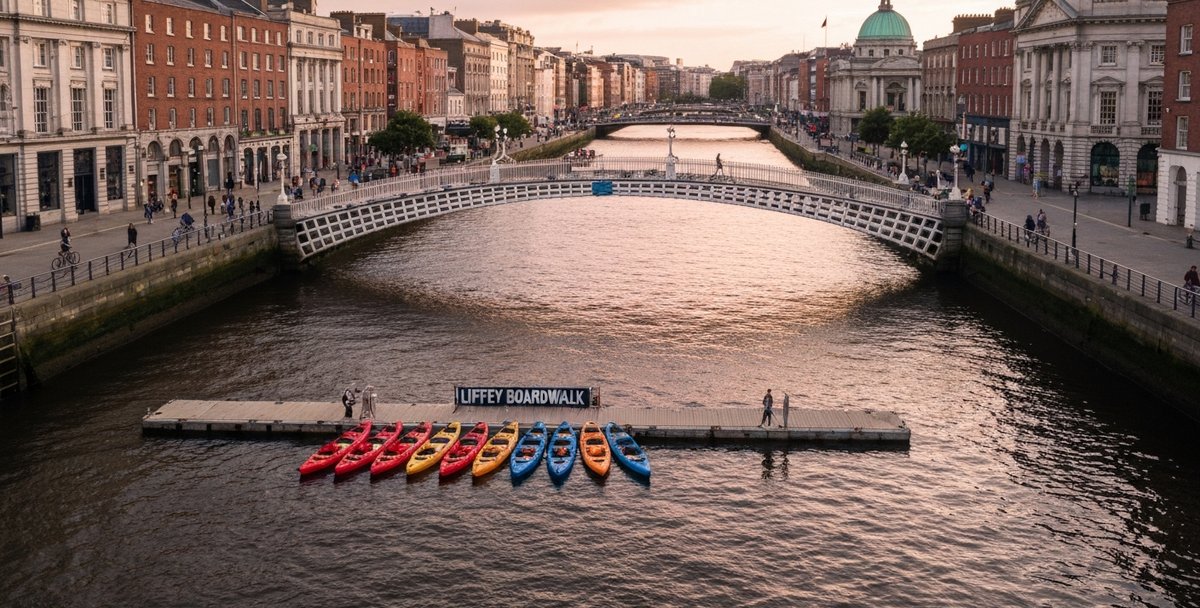
City Kayaking’s launch pontoon sits on the north-side boardwalk between the Ha’penny Bridge and O’Connell Bridge, one of the more visible tourist spots in the city, so every brief begins with a small crowd of pedestrians watching the kit-up. As of September 2026, City Kayaking no longer advertises unguided hourly single/tandem hire — its own site has dropped the “Rent a Kayak” listing, and its official Dublin tourism board partner page describes a guided-only 2-hour tour at €49 per adult / €45 per child, using double and triple kayaks with a guide. The water is tidal — the Liffey rises and falls roughly four metres twice a day in the city centre — so the guide’s briefing covers the direction of flow, the location of the next downstream weir at Islandbridge, and which Liffey bridges to avoid in low slack.
Two important things to know. First, confirm current pricing directly with the operator (info@citykayaking.com) before booking — tour rates change seasonally and the booking flow runs through a JavaScript widget that isn’t always reflected in cached listings. If you specifically want unguided self-paddle hire, call ahead to check whether it still exists in any form; as of this guide’s last check it did not appear to. Second, the Liffey downstream of O’Connell Bridge is open to commercial traffic — the Dublin Port tugs, the LÉ ships moored at Sir John Rogerson’s Quay, and the occasional river bus — so any City Kayaking session stays within a boundary the guide sets and briefs on the day, well clear of that traffic.
Boats are stable sit-on-tops and doubles/triples, not closed-cockpit sea kayaks. Suitable for anyone twelve years and up who can swim. Book online rather than walking up, since availability now runs through the tour calendar. Website: citykayaking.com.
Surfdock Watersports — Grand Canal Dock, Dublin 4
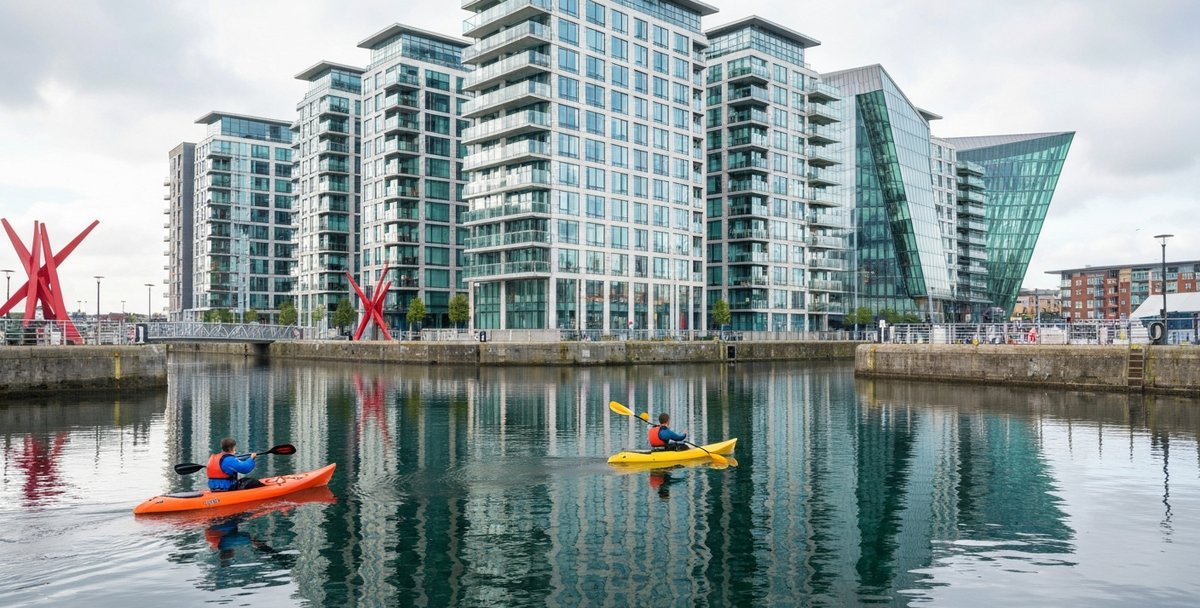
Surfdock runs a year-round model and, checked directly against its own site in September 2026, is the cheapest verified option in the city. The launch is on the south-east corner of Grand Canal Dock, a Georgian-era basin two minutes’ walk from the Grand Canal Dock DART station and roughly five minutes from the Spencer Dock terminus of the Luas Red Line. The product is a supervised one-hour Kayaking Solo Trip at €20 per person in a single sit-on-top (wetsuit, buoyancy aid and — for under-18s — a helmet included; a €5 non-refundable booking fee applies). There is no tandem/double kayak option and no self-guided hourly rental structure — it’s a fixed-price, fixed-duration supervised session. The basin itself is fully enclosed by quayside, with no current, no boat traffic of any consequence, and protection from the wind on three sides — by some distance the most beginner-friendly water in the city.
Older listings for Surfdock describe an off-site day-rental option and a tandem/hourly rate — neither appears on Surfdock’s current site, and Wayback Machine snapshots going back to 2024 show the same single-session, single-kayak structure throughout, so there’s no evidence Surfdock has ever run a take-home day-rental scheme. If you want to launch independently at Bull Island, Sandymount, Dollymount, Skerries, Howth or a Wicklow lake, you’ll need to own or borrow a boat rather than rent one for the day in Dublin — see our kayak trolley guide and ownership cost breakdown further down this page.
Surfdock is also the city’s de facto windsurf and SUP school, so the kayak session sits within a wider watersports operation rather than being the centre of the business model. Online booking is straightforward through the Surfdock website. The dock can get busy in summer with paddleboard classes — book a morning slot if you want quiet water. Website: surfdock.com/pages/kayaking.
Portobello Adventure — Grand Canal, Dublin 8
Portobello Adventure has operated from the towpath beside Portobello Harbour on the Grand Canal in Dublin 8, with an entry point a couple of hundred metres west of the Portobello Bridge, and previously advertised self-paddle rental at €15 to €20 per hour for a 5.5 km canal loop west towards Inchicore and back. As of September 2026 its website (portobelloadventure.ie) is deregistered and unreachable, and a recent customer review describes cancelled bookings with no response — call ahead to confirm the operator is still running before relying on this option. The water itself is flatwater with effectively zero current — the Grand Canal sits between locks at Portobello and Suir Road — though Grand Canal Dock and Portobello Harbour do host permanently moored barges, so it isn’t fully traffic-free the way pure flatwater implies. Wildlife sightings include the resident grey heron population, kingfisher in the right month, and an unusually large urban swan flock at Portobello Harbour.
A Groupon-style discount voucher for this operator has circulated in the past, but as of September 2026 the operator’s own website and its LivingSocial-linked booking domain are both offline, and LivingSocial no longer runs as an independent Irish deals platform (it has folded into Wowcher) — treat any old Portobello discount voucher as unverified until the operator confirms it’s still trading. The operator has also run Stand-Up Paddleboard rental and SUP yoga sessions on the same water in the past. There is no confirmed real-time online booking option currently. Last known website: portobelloadventure.ie (unreachable as of Sept 2026).
Kayaking.ie — Royal Canal Blueway, Confey, Leixlip
Kayaking.ie is the operator that runs the Liffey kayaking tours from the Custom House Quay and Dalkey Island sea kayaking tours from Coliemore Harbour, but they also run a less-known Royal Canal Blueway tour from the Royal Canal amenity group centre just outside Leixlip, at Confey, Co. Kildare — a short drive or train ride out from the city rather than a Dublin city-centre launch. This is a guided 2½-hour tour rather than self-paddle hire: it’s suitable for complete beginners, with the gear supplied and the guide leading the group along the flat canal water. Checked directly against Kayaking.ie’s own Royal Canal page in September 2026.
The Royal Canal Blueway is part of the national network of designated Irish blueways. For a first paddle, it’s about as forgiving as Dublin-region water gets — no current, no tide, locks at both ends limiting boat movement, towpath access for a quick exit if anything goes wrong — though it isn’t traffic-free in an absolute sense, since the towpath and locks see other canal users. Pricing varies by season and group size — confirm at booking.
Kayaking.ie’s wider product range is worth knowing about because rental customers regularly come back for guided sea kayaking. The Dalkey Island tour is the most popular sea-kayak product in the wider Dublin region and a clean step-up from canal flatwater to sheltered open sea — current pricing is set through Kayaking.ie’s own online booking system rather than published on the page, so don’t rely on a fixed €-figure without checking there first. Website: kayaking.ie.
Skerries Watersports — Skerries Bay, North County Dublin
Skerries Watersports operates from the South Strand beach at Skerries, a forty-minute drive or train ride north of Dublin city centre. The model here is a 90-minute sea-kayak rental session rather than a true hourly rate, with full kit including a 3 mm wetsuit, buoyancy aid, paddle, sit-on-top kayak and an on-site safety brief. The water is the sheltered south side of Skerries Bay — Red Island and the line of small offshore islets (St Patrick’s Island, Shenick Island, Colt Island and Rockabill) provide a natural break from the worst of the north-easterly swell, so the bay sees usable rental conditions far more often than the coast immediately to the south at Loughshinny or to the north at Balbriggan.
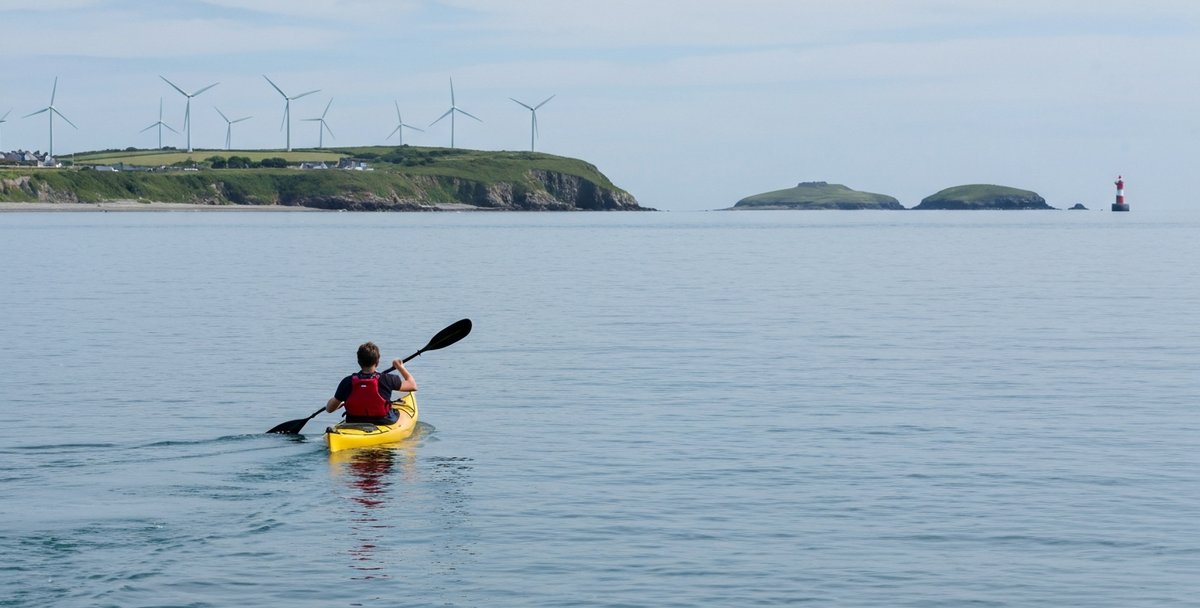
Skerries is the operator on this list with the most credible step-up from a flatwater first paddle to genuine sea kayaking. The bay is a beginner-to-intermediate environment in benign conditions — Force 3 or under, swell under 1 metre, slack to mid-tide — and on those days you can reach Colt Island in twenty minutes from the beach. On stronger days the operator will rebook your session to a calmer window rather than launch into marginal conditions, which says something about the safety culture. The session (branded “Kayaking Sundowner”) is bookable online from €40 per person, checked directly against the operator’s own booking system in September 2026 — book at least 48 hours in advance via the website. Website: skerrieswatersports.ie.
Choosing Where to Launch — Water-Type Decision Tree
Different rental operators give you fundamentally different paddling experiences. The five water types available in the Dublin region — basin, canal, tidal river, blueway and sheltered sea — call for different fitness, different skill, and different mindsets about wind and weather. The table below maps experience level to the recommended water type and the operators that work for each.
| Experience | Recommended water | Operator | Why |
|---|---|---|---|
| First-ever paddle | Sheltered basin or blueway | Surfdock (Grand Canal Dock) or Kayaking.ie (Royal Canal) | No current, sheltered water, guide or supervisor handles the rest |
| Confident beginner | Sheltered canal | Portobello Adventure (Grand Canal) — confirm operating status first | Flatwater, herons, no waves, 5 km loop |
| City-walking paddler | Tidal river | City Kayaking (Liffey, guided tour) | Iconic views, guide handles the current, structured zone |
| Beginner with sea ambition | Sheltered sea bay | Skerries Watersports | Wetsuit included, structured session, weather call by guide |
If you have never sat in a kayak before, the right answer is Surfdock Grand Canal Dock or Kayaking.ie on the Royal Canal. The basin and the blueway are essentially flat water inside a sheltered corridor — there is no current to fight, no swell, and minimal boat traffic. After that first session, the next step-up is Portobello Adventure on the Grand Canal (status permitting), then City Kayaking’s guided Liffey tour for the tidal-river experience, then Skerries for the sea introduction. Following this progression over a season is realistic — a full progression from first session to sheltered sea costs you somewhere between €100 and €150 across four outings, once City Kayaking’s tour price and Surfdock’s true per-session rate are accounted for.
What’s Included in a Dublin Rental
Standard Dublin rental kit covers boat, paddle, buoyancy aid and a safety briefing. Wetsuits are bundled at sea operators (Skerries) and available at extra cost at the canal and river operators in shoulder season. Dry bags for phones and wallets are loaned at most launches at no charge. Helmets are not standard for flatwater rental — Dublin operators reserve them for moving-water environments outside the city.
What is not included at any Dublin rental is footwear, clothing, water, sun protection, or transport home from the launch. Bring runners or sandals you can soak, a change of dry clothes for after, and a towel. Bring more water than you think you need — a full hour of paddling in the sun in July dehydrates faster than a walk does, and there are no drinking fountains on the canal towpath. Bring sun cream and a hat. If you are going to bring your phone on the water, double-bag it (waterproof case inside the operator’s dry bag is the safest setup).
Rental Versus Guided Tour Versus Lesson
A lot of first-time renters book the wrong product. The split between self-paddle rental, guided group tour and structured beginner lesson matters because each one solves a different problem.
Self-paddle rental is the cheapest, fastest and most flexible. You get the briefing, you get on the water, you paddle wherever the operator’s zone allows, and you come back when your hour is up. The trade-off is that nobody is going to teach you a correct stroke, nobody is going to read the weather on your behalf, and you are on your own for navigation. Best for: people who have paddled before, people who only want forty-five minutes of recreation, people travelling on a tight budget. Cost: €20–€40 for a supervised single-kayak session, since true unguided hourly hire is now rare in Dublin.
Guided tour is the cheapest way to see something — Dalkey Island, the Liffey bridges, the inside of Grand Canal Dock at dusk. A tour pairs you with a coach who reads the conditions, picks the route, points at the seals or the heron on the day, and keeps the group together. The trade-off is that you cannot leave the group and you cannot extend the session. Best for: tourists, photographers, first-time city paddlers who want a story. Cost: €49–€65 per person for two hours.
Structured beginner lesson is the one that pays off long-term. Two or three sessions with a qualified Canoeing Ireland Level 1 or Level 2 instructor teaches you stroke technique, edging, basic rescues and the conditions you can and cannot paddle in. Once you have those skills, every rental session afterwards is more productive and considerably safer. Best for: people who think they might be doing more than one paddle this year. Cost: €70–€95 per session. See our kayaking for beginners guide for the full lesson pathway and a list of Dublin instructors.
If you can only book one thing this year, book the lesson. If you can only afford one thing this year, book the rental. If you only want to enjoy a single nice afternoon on the water, book the guided tour.
Season, Weather and Tides — What You Can Hire and When
The core Dublin kayak rental season runs April through September, with shoulder weeks in mid-March and the first half of October. Three operators run reduced-hours service through winter — Surfdock keeps the Grand Canal Dock open year-round, City Kayaking takes occasional bookings off-season for confident paddlers, and Kayaking.ie can usually accommodate group bookings on the Royal Canal in any month with 72 hours’ notice.
Weather constraints are the most common reason a Dublin booking gets cancelled or rescheduled. On the Liffey, City Kayaking’s own stated policy is that tours go ahead rain or shine, with wind strength the only factor that triggers a cancellation or reschedule — the operator doesn’t publish an exact wind threshold, so treat a forecast with a strong westerly as a reason to check in before you travel. On Grand Canal Dock and the Grand Canal proper, wind is rarely a launch-stopper because of the surrounding buildings. On the Royal Canal blueway the same applies. Skerries Bay sees the most weather cancellations of any operator on this list — anything with a north-east in the forecast pushes the operator to reschedule.
Tides matter most on the Liffey. The river is fully tidal as far upstream as Islandbridge, with the strongest current around the Liffey Boardwalk approximately two hours before and after high water. City Kayaking schedules its guided tours to work with the tide rather than against it. If you own or borrow a boat and plan to launch independently from a tidal Dublin Bay location — Bull Island, Sandymount Strand, Dollymount — read the tide table for the Dublin Port standard port, plan around slack water, and check Dublin Port’s water safety guidance first: small craft crossing an active shipping lane need to call Dublin Port VTS on VHF Channel 12 for permission before crossing. The Met Éireann marine forecast covers Dublin Bay under the Carlingford Lough to Howth Head zone.
Cost Breakdown — Cheapest to Most Expensive
The full cost spectrum for self-paddle kayak rental in Dublin in 2026 is laid out below, from cheapest to most expensive published rate.
| Rank | Product | Price | Operator |
|---|---|---|---|
| 1 | Guided 1-hr Kayaking Solo Trip, single sit-on-top | €20 | Surfdock (Grand Canal Dock) |
| 2 | Self-paddle canal hour (status unconfirmed) | Unconfirmed | Portobello Adventure (Grand Canal) |
| 3 | Guided 2½-hr canal tour | Confirm via booking | Kayaking.ie (Royal Canal) |
| 4 | 90-min Kayaking Sundowner session | from €40 | Skerries Watersports |
| 5 | Guided 2-hr Liffey tour, adult | €49 | City Kayaking (Liffey) |
| 6 | Guided 2-hr Liffey tour, child | €45 | City Kayaking (Liffey) |
The cheapest verified kayaking session inside the M50 is Surfdock at €20 per person for a supervised one-hour Kayaking Solo Trip. Portobello Adventure’s old Groupon-era rate cannot currently be verified, since the operator’s booking infrastructure is offline. There is no day-rental option currently available from any Dublin operator — Surfdock’s advertised day-rental scheme does not appear on its current site or in its booking history going back to at least 2024. For comparison, hourly rental in Cork at City Kayaking Cork is €25 per hour, in Galway at Rusheen Bay is €25 for two hours and in Killarney at Wild N Happy is €30 per hour. Dublin’s genuinely self-paddle options have narrowed since this guide was first published, and pricing now leans toward supervised sessions rather than pure hourly hire.
What to Bring, What to Wear
You will be wet by the end of a self-paddle Dublin rental, even if the briefing assures you that you will not be. Splash on entry and exit is inevitable; paddle drip soaks the front of trousers; and if you have a tandem with someone who paddles harder than you, water will arc into the back of the boat. Plan accordingly.
Clothing for the boat: quick-drying shorts or leggings, a tech tee or a long-sleeve rashie that will not chafe under a buoyancy aid, runners or sandals you can soak. No cotton — cotton holds water, takes hours to dry, and steals body heat. In May and September add a long-sleeve thermal under the rashie. Wetsuit is provided at Skerries; optional at City Kayaking and Surfdock for an extra fee in shoulder months; not provided on the canal operators because canal flatwater rarely produces significant splash.
Clothing for after: a full set of dry clothes, a towel, and a plastic bag for your wet gear. Dublin operators have changing facilities but most are not heated and the queue can be long. Get changed and walk to a coffee shop to warm up.
On the water: sunglasses with a leash, sun cream applied 30 minutes before launch, a hat that will not blow off in 15 knots of wind, and at least 500 ml of water for an hourly rental or 1 litre for a two-hour session. The operator’s dry bag will hold a phone, wallet and keys.
What to leave in the car: wallet, jewellery, watches you are not happy to soak. There are no left-luggage facilities at any of the Dublin launches, so what you cannot put in the dry bag stays in the car.
Kids, Groups and Accessibility
Most Dublin operators take children from twelve years upwards in a single boat and from eight years upwards in a tandem with an adult. City Kayaking, Surfdock and Portobello Adventure all run group bookings of up to 20 paddlers with advance notice. Stag and hen groups are common at Surfdock and on the Liffey — book the morning slot to avoid them if you want a quieter session.
Accessibility for paddlers with mobility limitations is best at Surfdock Grand Canal Dock, where the launch is a step-down pontoon at quayside height with railings either side and no climb-over. Kayaking.ie’s Royal Canal launch is a grass-and-towpath entry with a gentle bank — manageable for many but not formally accessible. City Kayaking’s Liffey pontoon has a single boarding ladder and is the least accessible of the city launches. None of the Dublin operators currently advertises a formal adaptive-paddling programme, and any specific accessibility requirement is best discussed directly with the operator before booking.
Safety and Practical Considerations
Two safety items deserve specific mention beyond what the launch briefing will cover.
Cold water shock is a real risk on the Liffey, Dublin Bay and Skerries year-round, even in July. Sea surface temperatures in Dublin Bay sit at roughly 14 °C in mid-August, 13 °C in September, 11 °C in May, 8 °C in March. Cold water shock causes an involuntary gasp reflex on immersion and can incapacitate even strong swimmers for the first ninety seconds in the water. Wear a wetsuit or thermal layer on every sea outing regardless of air temperature; on the Liffey and the canals, wear enough that an unexpected swim does not become a hypothermia risk. The Irish Water Safety cold-water-shock guidance is the reference document.
Liffey downstream shipping is the second concern. City Kayaking keeps its guided tour within a boundary well clear of the deepwater shipping channel further downstream, where there are regular tug movements, Stena ferry traffic at the Alexandra Basin, and the occasional naval visit. Getting closer to Dublin Port itself means booking a guided tour rather than attempting it independently — the operator carries insurance, escort cover and pre-coordination with the harbour master, and unescorted small craft crossing an active shipping lane need permission from Dublin Port VTS first.
Beyond Rental — Clubs, Lessons and Owning Your Own Boat
Once a season of rental has confirmed that you actually like this, three steps make the next year cheaper and more interesting.
Join a club. Dublin has fifteen-plus paddling clubs covering everything from sea kayaking to slalom to flatwater racing. Membership starts at around €120 per year and unlocks pool sessions, river trips and boat loans. The full county-by-county club list with what each one specialises in is in our kayaking clubs in Ireland guide.
Do a Canoeing Ireland Level 2 or Level 3 course. The Level 2 takes a beginner to competent paddler over two weekends; Level 3 adds rescue and trip-leading skills. Pricing for the full Level 2 course in Dublin sits around €180–€220 in 2026, which is roughly the cost of ten rental sessions but delivers permanent skill. See the kayaking for beginners pathway for course structure and Dublin providers.
Own your own kayak. A second-hand sit-on-top in Dublin costs €350–€600 on DoneDeal or Adverts.ie, plus another €120 for paddle and PFD. A roof rack and a kayak trolley will add €150–€250 — see the kayak trolley guide for picks. Paddle only a handful of times a year and rental stays cheaper. Paddle often enough and ownership starts to pay for itself against what repeat rental sessions would have cost.
Frequently Asked Questions
What is the cheapest kayak rental in Dublin? Surfdock Watersports at Grand Canal Dock is the cheapest verified option, at €20 per person for a one-hour guided single-kayak session. Portobello Adventure’s older Groupon-era rate cannot currently be verified since the operator’s booking infrastructure is offline.
Do I need experience to rent a kayak in Dublin? No. Every operator on this list provides a safety briefing before you get on the water, and the canal and basin sessions (Surfdock, Kayaking.ie, and Portobello Adventure where it’s operating) are designed for first-time paddlers. City Kayaking’s Liffey tour and Skerries’ sea session are both guided, so the operator reads conditions and makes the call on whether to launch.
Can I rent a kayak in Dublin in winter? Yes, but only from Surfdock Grand Canal Dock, which is year-round. Kayaking.ie can sometimes accommodate off-season bookings with notice. The other operators run a seasonal April–October window.
How much does kayak rental cost in Dublin? A typical first-time session runs €20–€40 per person — €20 for Surfdock’s one-hour guided single-kayak session, from €40 for Skerries’ 90-minute sea session. City Kayaking’s guided Liffey tour is €49 for an adult / €45 for a child. There is currently no verified day-rental option in Dublin.
Is the Liffey safe to kayak? Within City Kayaking’s guided tour, yes — the guide picks a tidal window, keeps the group inside a boundary set for the day, and stays well clear of the deepwater shipping channel further downstream. Self-paddle hire on the Liffey isn’t currently available, so there’s no unguided option to weigh up: the river is tidal with a strong current on spring tides, and it isn’t a stretch to attempt without a guide.
Where can I rent a kayak in Dublin Bay? There is no operator currently offering self-paddle kayak rental directly on Dublin Bay sand, and Surfdock does not run a day-rental scheme to fill that gap. Skerries Watersports, forty minutes north of the city, is the closest bay-adjacent option. For Dublin Bay guided tours, Kayaking.ie runs sea kayaking from Coliemore Harbour to Dalkey Island.
Can I rent a kayak on the Grand Canal? Yes. Two operators — Surfdock at Grand Canal Dock in Dublin 4 and Portobello Adventure on the Grand Canal in Dublin 8 — both offer hourly rental on the canal system. Surfdock launches into the enclosed basin; Portobello launches into the canal towards Inchicore.
Do I need a permit to kayak in Dublin? No. No personal licence or Waterways Ireland permit is required to paddle a kayak or canoe on the Grand Canal, Royal Canal, or any Dublin waterway — open, oar-propelled craft like kayaks and canoes are specifically exempt from Waterways Ireland’s annual canals permit, which applies to powered and moored boats. Rental operators don’t need to bundle a permit cost into your hire because none is required.
Also Read
- Kayak Rental Ireland — the full national directory of verified operators — the master rental directory this guide feeds from, covering every county on the island.
- Kayaking Dublin — every paddling zone in the capital — the Dublin pillar guide, with all ten of the city’s paddling spots covered in depth.
- Kayaking for Beginners Ireland — your first paddle guide — what to expect on your first session, plus a Canoeing Ireland Level 1 and Level 2 course pathway with Dublin providers.
- Kayaking Clubs in Ireland — 45 verified clubs by county — the long-term answer to rental fees: join a club and access boats at a fraction of the rental cost.
- Blueways Ireland — every paddling trail mapped — the Royal Canal blueway is part of this national network.
- Sea Kayaking Ireland — the complete paddler’s guide — once Dublin Bay rental gets you hooked, the sea kayaking step-up starts here.
Planning Your Trip — Summary
Dublin’s kayak scene covers the full water spectrum from sheltered Georgian basin to canal flatwater, from tidal city river to sheltered north-coast sea — but it has shifted toward supervised sessions and guided tours rather than pure hourly self-paddle hire, and prices now start at €20 per person. The right first booking depends on what kind of paddling you want to do: Surfdock or Kayaking.ie for first-timers, Portobello for a relaxed canal hour (call ahead to confirm it’s operating), City Kayaking’s guided tour for the iconic Liffey shot, Skerries for the sea introduction. Book online a week in advance for peak summer slots. Bring runners you can soak, sun cream, and at least 500 ml of water. Anything bigger than a single afternoon session, follow it with a structured Level 2 course — and the second year of paddling pays for itself.

No comments yet on this guide.
Be the first to share your experience — conditions, access, hazards, or anything a future paddler should know.
Login to join the discussion