Cork has two rivers running through the middle of its second city and one of the largest natural harbours on the Atlantic seaboard sitting on its doorstep. Search “kayaking cork” and the results are dominated by operators an hour and a half west, on the Mizen and around Lough Hyne — brilliant water, but not Cork Harbour, and not the River Lee. This guide covers the ground that gets skipped: the harbour itself, from Crosshaven to Cobh to Spike Island; the tidal river that splits Cork city in two; Fota Island on the harbour’s eastern shore; and Kinsale, where the harbour meets the open Atlantic.
If you want the far west — Lough Hyne’s bioluminescence, Baltimore, Schull, the Mizen Peninsula, Bantry Bay — that is a different trip and a different guide. See Kayaking West Cork for all of it, including the midnight paddles. This guide is the harbour, the city, and the coast either side of the harbour mouth.
If you want operators and prices first, skip to the operators and hire section below. Otherwise start with the four zones.
The Four Zones at a Glance
Cork’s paddling geography runs from the tidal river in the city centre, out through the harbour to Cobh and Crosshaven, across to Fota Island on the eastern shore, and south-west to Kinsale where the coast opens onto the Atlantic.
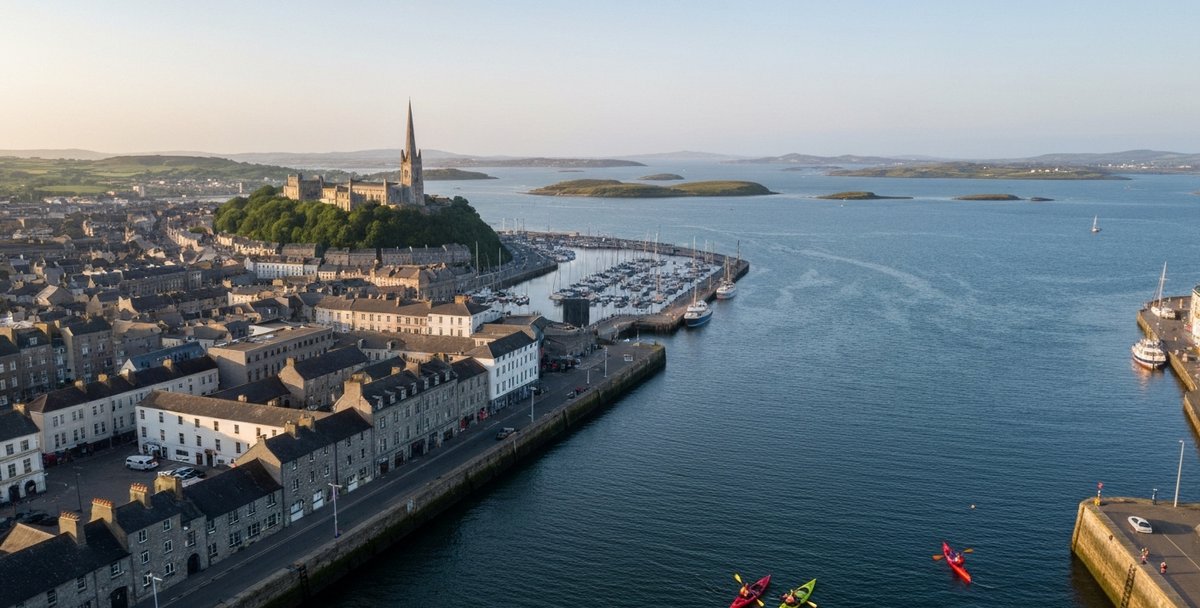
Zone 1 — Cork Harbour: Crosshaven, Cobh and Spike Island is the main event — one of the largest natural harbours in the world, with a working naval base, a former convict prison turned heritage site, and mostly sheltered water — though as a working port, exposure, tide, wind and shipping traffic vary by location.
Zone 2 — The River Lee Through Cork City is the six-kilometre urban stretch where the Lee splits into two channels around the historic city centre — a genuine city paddle, with a real hazard in the weirs on the way down.
Zone 3 — Fota Island and East Cork Harbour covers the quieter eastern shore of the harbour, sheltered kayaking off Fota Island and the internationally important wetlands nearby.
Zone 4 — Kinsale and Sandycove is the coast just outside the harbour mouth, a smaller, more intimate harbour with a star fort, a famous open-water swim course, and operators running year-round.
| Zone | Difficulty | Water | Beginners OK | Best Season | Access |
|---|---|---|---|---|---|
| Zone 1 — Cork Harbour | Beginner–Intermediate | Sheltered natural harbour | Yes (guided) | Apr–Oct | SailCork, Funkytown |
| Zone 2 — River Lee (city) | Beginner (club) / Advanced (weirs) | Tidal urban river | Club/guided only | Apr–Sep | Phoenix Kayak Club, Lee Fields |
| Zone 3 — Fota Island | Beginner | Sheltered estuary | Yes | Summer | Fota Island Adventure |
| Zone 4 — Kinsale & Sandycove | Beginner–Intermediate | Sheltered harbour + coast | Yes (guided) | Year-round (partial) | Atlantic Offshore Adventures, Oysterhaven |
Zone 1 — Cork Harbour: Crosshaven, Cobh and Spike Island
Cork Harbour is routinely described in Cork tourism material as the second-largest natural harbour in the world. That claim is worth a moment’s honesty: even Wikipedia’s own entry hedges it, noting Cork is “one of several” harbours that lay claim to the title — Halifax in Canada, Poole in England and Trincomalee in Sri Lanka all make the same case, and no single authoritative ranking settles the argument. What is not in dispute is the scale. The harbour splits into an Upper reach, running from the River Lee down past Passage West and Monkstown, and a Lower reach around Great Island, and most of it offers sheltered paddling water, though as a working harbour, exposure, tide, wind and shipping traffic vary by location.
Cobh, on Great Island, is the harbour’s best-known town — built on a steep hillside under the spire of St Colman’s Cathedral, and famous as Titanic’s last port of call. The liner anchored off Roches Point on 11 April 1912, when it was still known as Queenstown; tenders ferried around 123 passengers out to board her, and fewer than half of that group survived the sinking four days later. The name reverted to Cobh in 1920. It is a striking thing to paddle past with that history in mind.
Spike Island, near the harbour mouth, is a 104-acre island with a six-bastioned star fort — Fort Mitchel, begun in 1804 — that grew into one of the largest prisons in the British Empire during the Famine era, holding more than 2,300 inmates at its peak. The island’s story runs further back than that: a monastic site here dates to around the 7th century, and the fort itself was garrisoned for up to 3,000 men at various points. It stayed a working prison until 2004 and is now run as a heritage attraction by Cork County Council, reachable by ferry from Cobh, its star-shaped walls clearly visible from the water on the approach into the Lower Harbour.
Between them, Cobh, Spike Island and Haulbowline give a compact stretch of water that carries an outsized amount of Irish and naval history — a monastery, a Famine-era prison, a naval headquarters and Titanic’s final anchorage, all inside a couple of kilometres of paddling.
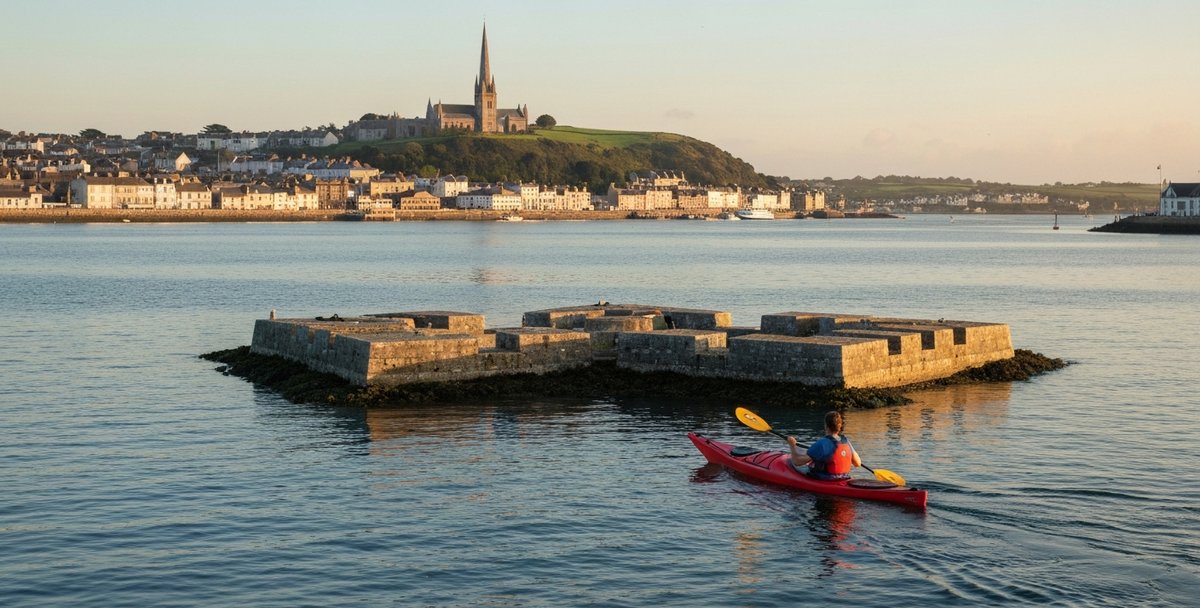
Haulbowline, the island next to Spike, has been the main headquarters of the Irish Naval Service since the Royal Navy handed the dockyard over to the Irish Free State in 1923. There is no publicly documented minimum-distance rule for kayakers around the base, so the sensible approach is the general one: keep well clear of naval and commercial vessel movements, do not approach the base itself, and give way to anything bigger than you, which in this harbour is most things.
Closer to the city, Blackrock Castle sits on the Lee about two kilometres from the centre — built in 1582 to defend the harbour against pirates, rebuilt twice after fires in the 18th and 19th centuries, and now an observatory and science centre run with Munster Technological University. It is a natural landmark for a shorter paddle out from the city.
For self-paddle and guided options inside the harbour, SailCork operates from East Ferry Marina on Great Island, about twenty minutes from Cork city and close to Cobh — a genuinely sheltered inner-harbour spot the operator itself describes as one of the most secure locations on the south coast. Funkytown, based at Fountainstown near Crosshaven on the harbour’s southern shore, runs kayak hire and courses from Morrissey’s Slip, with single, double and triple sit-on-tops.
Commercial shipping is a real factor here — Cork Harbour takes vessels up to roughly 90,000 tonnes deadweight below Cobh, and Port of Cork traffic uses a working channel through the harbour. Stay well outside the main shipping channel, cross it at right angles if you must, and monitor VHF Channel 12, the working channel for Cork Harbour Radio and Port of Cork operations — Channel 16 is for distress and initial calling only, not routine traffic.
Between the city and Crosshaven, Passage West sits on the harbour’s western shore — historically the deep-water point where cargo transferred to smaller boats because larger vessels couldn’t get any further upriver to Cork, and a 19th-century bathing resort in its own right, with a ferry crossing to Great Island recorded since the 1600s. It’s a reminder that this harbour has been worked, crossed and lived on for centuries before anyone thought to paddle it for fun — and once a year, typically on a Saturday in late May or early June, it briefly becomes one of the most watched stretches of water in the county, as a checkpoint on the Ocean to City race, a mixed-craft event that brings currachs, rowing boats and paddlers of every kind down from Lee Fields to the harbour mouth.
Key logistics — Zone 1:
- Guided/hire: SailCork, East Ferry Marina, Great Island — sailcork.com; Funkytown, Fountainstown, Crosshaven — funkytown.ie
- Difficulty: Beginner–Intermediate; mostly sheltered, but this is a working port — exposure, tide, wind and shipping traffic vary by location
- Landmarks on the water: Cobh and St Colman’s Cathedral, Spike Island’s star fort, Blackrock Castle
- Hazard: Commercial shipping channel; keep clear of the naval base at Haulbowline
- Season: April–October for most operators
Zone 2 — The River Lee Through Cork City
No other Irish city splits around its own river quite like Cork. The Lee divides into a North Channel and a South Channel as it reaches the city centre, and the historic core sits on the resulting island — a legacy of the marshy, estuarine settlement the Vikings founded here, with the medieval city walls once running along what are now North and South Main Streets. It is a genuinely unusual paddle: bridges, quaysides, and the compressed skyline of Ireland’s second city on both sides, all on tidal water.
It is also not a river to improvise on. One detailed paddling-community route guide describes five weirs with dangerous drops on the South Channel between the city centre and the harbour, plus a rougher gravel-bed weir at the end of the North Channel. There is no charted, authoritative weir-clearance table for the Lee, and no equivalent here to the formally investigated weir incident on Galway’s River Corrib — no Marine Casualty Investigation Board report exists for this stretch. What is clear is that the weirs are a real, physical hazard, confirmed independently by paddlers who have run the river: do not attempt the tidal city-centre section, weirs included, without a local paddler or club member who knows the current state of the river first-hand.
Phoenix Kayak Club, based at Lee Fields on Lee Road, has paddled this stretch of the river since the early 1980s. Lee Fields itself — upstream of the city, above the tidal boundary at the Lee Fields weir — is a flat, non-tidal amenity stretch, and it is where most of the club’s regular paddling happens, well clear of the city-centre weirs and shipping traffic downstream. The club covers sea kayaking, river paddling, whitewater and competitive paddling, and 2026 membership runs €50 juvenile, €100 adult or €170 for a family, which includes Canoeing Ireland registration. Full membership needs at least a Level 2 kayaking award; newcomers typically start on the club’s Learn to Kayak course, €150 adult or €110 juvenile over a four-week block in June and July — though the 2026 course slots were already full at the time of writing, so anyone interested should register early for 2027.
A guided paddle through the city itself has existed — Atlantic Sea Kayaking’s Cork City Tours, launching from the Lapp’s Quay boardwalk, historically ran a 2.5-hour trip under the city’s bridges for around €60 per person between June and August. At the time of writing this product is reported suspended because of port construction work in the city, so check current availability directly before planning a trip around it.
Key logistics — Zone 2:
- Club: Phoenix Kayak Club, Lee Fields, Lee Road — pkc.ie — €100 adult / €50 juvenile / €170 family membership 2026
- Difficulty: Beginner on Lee Fields (non-tidal); Advanced only on the tidal city-centre weirs
- Critical hazard: Five weir drops on the South Channel between the city and the harbour — do not run this section without a local paddler or club member who knows current conditions
- City-centre guided tour: Historically available via Atlantic Sea Kayaking (Lapp’s Quay) — currently reported suspended for port works, confirm before booking
Zone 3 — Fota Island and East Cork Harbour
The eastern shore of Cork Harbour, around Fota Island, is the gentlest paddling in this guide. Fota Island Adventure, based at the resort in Tullagreen, runs sit-on-top kayak sessions on sheltered harbour water throughout the summer — a flat rate of €30 per person for a one-hour session, whether you take a single, double or treble kayak, with a minimum age of eight. It is the straightforward family option in this guide, and the closest thing Cork Harbour has to Galway’s Rusheen Bay: instructor-led and sheltered, though the operator notes sessions are tidal and bookings can change or be cancelled around the water.
The wider East Cork Harbour shore is also one of the best wildlife stretches in this guide, even if it is better known to birdwatchers than paddlers. Cork Harbour has been a Ramsar-listed wetland since 1996 and carries Special Protection Area status, regularly supporting more than 20,000 wintering waterfowl, with internationally important numbers of Black-tailed Godwit and Redshank. Harper’s Island Wetlands, a thirty-hectare site near Glounthaune on the harbour’s northern shore, records godwit counts in spring that exceed four per cent of the entire global population, according to Birdwatch Cork — a genuinely significant number for a site most visitors have never heard of. It’s a reserve to view from open water at a respectful distance rather than a landing spot; a quiet paddle along this shore in autumn or winter, giving roosting and feeding birds plenty of room, with wigeon and teal working the mudflats, is a different kind of Cork Harbour experience to the working port further downstream.
Key logistics — Zone 3:
- Hire: Fota Island Adventure, Fota Island Resort, Tullagreen — fotaadventure.com — €30/person, 1hr, min age 8
- Difficulty: Beginner; sheltered estuary water
- Season: Summer only
- Wildlife: Harper’s Island Wetlands (Glounthaune) — internationally important wintering wader numbers, best October–March
Zone 4 — Kinsale and Sandycove
South-west of Cork Harbour, past the naval station at Haulbowline, Kinsale sits on its own smaller, more sheltered harbour, where the Bandon River meets the sea. It is a different character of paddle to the working port upriver — a fishing-and-yachting town, a 17th-century star fort, and a coastline that opens onto the Atlantic proper once you clear the harbour mouth.
Charles Fort, at Summer Cove on the harbour’s east side, is a star-shaped fortification built between 1677 and 1682 to a design by Sir William Robinson, the same architect behind Dublin’s Royal Hospital Kilmainham. It survived a thirteen-day siege during the Williamite War in 1690, when the Earl of Marlborough’s forces — John Churchill, later created Duke of Marlborough — took the harbour, and is now a National Monument run by the OPW — visible from the water on any paddle toward the harbour entrance. Sandycove Island, a small island just offshore near Ardkilly Creek on the harbour’s western approach, gives its name to the Sandycove Island Challenge, an open-water swim run since 1994 that circles the island on a course of around 1.6 kilometres. The event has built a real marathon-swimming community around it — Kinsale’s Sandycove hosts Cork Distance Week, a well-known open-water training camp, and the swim itself has been ranked among the world’s top open-water and island swims by international swimming bodies. It’s worth knowing this is a different Sandycove entirely from the one in Dún Laoghaire, County Dublin, made famous by James Joyce’s Martello tower — the two are easy to confuse online, and only one of them is on the Cork coast.
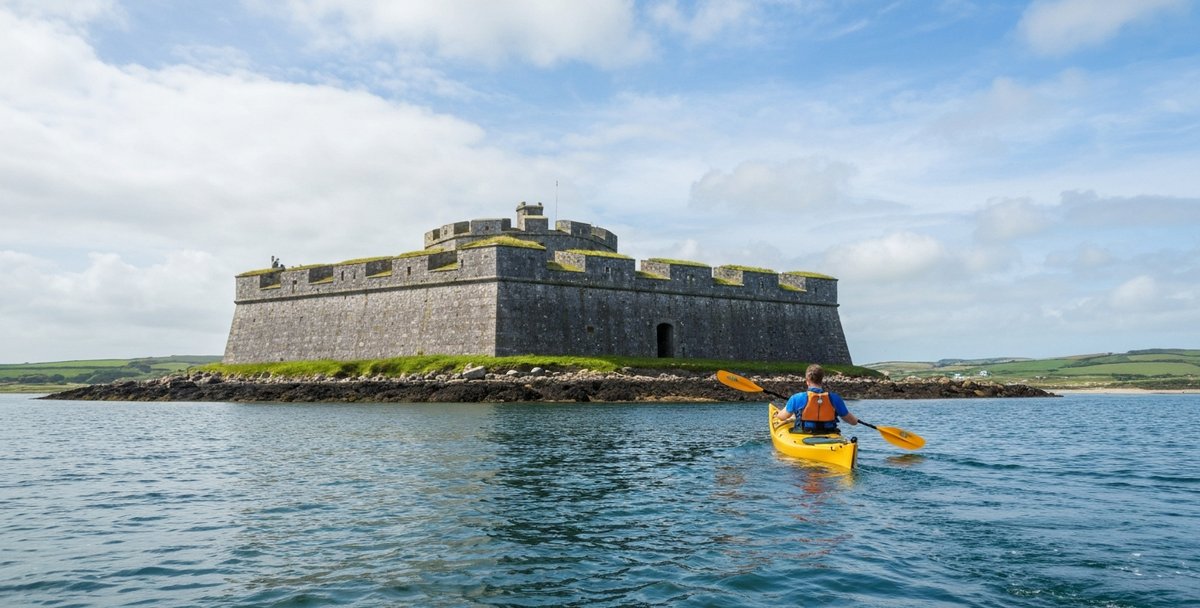
Atlantic Offshore Adventures, launching from Dock Beach in Kinsale Harbour with views of both Charles Fort and James Fort, is one of the few Cork operators genuinely running year-round rather than a summer-only season, alongside seasonal children’s camps. Confirm current pricing directly — call ahead, since published rates vary across third-party listings. A short distance outside Kinsale, at Oysterhaven Bay, the Oysterhaven Centre runs straightforward self-paddle kayak hire from May: a single kayak costs €12 for the first hour, half that for the second, with a wetsuit available for an extra €5 and a minimum age of four for accompanied children.
Key logistics — Zone 4:
- Guided: Atlantic Offshore Adventures, Dock Beach, Kinsale Harbour — atlanticoffshoreadventures.com — one of the few year-round Cork operators
- Self-paddle hire: Oysterhaven Centre, Oysterhaven Bay — oysterhaven.com — €12/hr single kayak, from May, min age 4
- Difficulty: Beginner–Intermediate; sheltered inside the harbour, more exposed at the mouth
- Landmark: Charles Fort, Summer Cove — visible from the water
- Season: Atlantic Offshore Adventures year-round, including winter (checked Sept 2026); Oysterhaven seasonal from May
Wildlife on the Water
Cork Harbour’s wildlife case is built on scale rather than spectacle. The whole harbour has carried Ramsar wetland status since 1996 and Special Protection Area designation since, and it regularly holds more than 20,000 wintering waterfowl between October and March — internationally important numbers of Black-tailed Godwit and Redshank among them, alongside nationally significant counts of grebes, cormorants, herons and a full suite of dabbling ducks. Harper’s Island Wetlands, on the harbour’s northern shore near Glounthaune, is the best-known site for this: a thirty-hectare reserve where spring godwit counts have exceeded four per cent of the entire global population, according to Birdwatch Cork — a genuinely startling figure for a site most visitors to Cork have never heard of. It’s a wetland reserve for viewing from a distance, not a landing or launch spot: BirdWatch Ireland recommends giving roosting and feeding waterbirds around 40 to 50 metres of space, and more if they start moving away from you.
Seals are present around the wider Cork coast, and researchers at UCC’s Coastal and Marine Resources Centre — based at the naval base on Haulbowline itself — study harbour seals in the area, but there is no well-documented resident colony inside Cork Harbour proper in the way there is at Glengarriff further west in West Cork. Treat any seal sighting in the harbour as a genuine bonus rather than a guaranteed feature of the trip, and don’t expect the reliable haul-outs you’d get on the open Atlantic coast.
Kinsale and Oysterhaven, being more open to the sea, carry more of the general south-coast marine life — harbour porpoise offshore, seals working the rockier stretches around the harbour mouth — though again, none of it is as reliably concentrated here as it is on the more exposed coastlines covered in our West Cork guide.
Getting There
Cork city is Ireland’s second-largest urban area and sits on the N/M8 from Dublin (around 2 hours 30 minutes), the N/M20 from Limerick, and the N25 from Waterford and Rosslare. Cork Airport, a few kilometres south of the city, has connections across Ireland, Britain and continental Europe, and Ringaskiddy on the harbour’s eastern shore takes ferries from Roscoff and Santander.
Within the county: Crosshaven and Fountainstown are about a 25-minute drive south of the city via the R612; Cobh is roughly 25 minutes east on the N25/R624, with a direct rail line from Cork Kent Station; Fota Island sits just off the same road, a few minutes short of Cobh; Lee Fields, for Phoenix Kayak Club, is a five-minute drive or a longer riverside walk/cycle from the city centre; and Kinsale, with Oysterhaven just beyond it, is about 25 minutes south-west on the R600.
Tides, Weather and Safety
Tides
Cork Harbour’s tidal range runs to roughly four metres on spring tides and under two metres on neaps — treat any published single figure as approximate, since reference sources for the harbour do not fully agree. Currents inside the harbour rarely exceed two knots, but pick up to around three knots at the narrows between Ringaskiddy and the West Passage (Cork Harbour sailing directions). Kinsale’s harbour entrance has its own significant tidal flow, with a spring range around 4.3 metres, and a known hazard at Bulman Rock between Kinsale and Oysterhaven — a submerged rock with just over a metre of water above it at low tide, best given a wide berth rather than approached on a transit line meant for larger vessels (Kinsale sailing directions).
On the River Lee, the tidal boundary sits at the Lee Fields weir upstream of the city — everything from there down through the city centre and out into the harbour is tidal, and the weir hazards downstream are not a stretch to run independently at any state of the tide.
Weather
Met Éireann’s marine forecast covers this coast under the sea area Roches Point to Mizen Head to Loop Head — check it before any harbour or coastal outing. Cork Harbour’s scale and shelter mean conditions inside stay workable in wind that would close the open coast at Kinsale or beyond, which makes the harbour the natural fallback on a rough-forecast day.
| Force | Wind (knots) | Cork advice |
|---|---|---|
| F0–F2 | 0–6 | Workable across the harbour, Lee Fields, Fota and Kinsale in most conditions — still check wind direction, tide state and your own skill level first |
| F3 | 7–10 | Harbour and Lee Fields remain manageable for most paddlers, depending on wind direction and tide. Outside Kinsale Harbour, experienced paddlers only |
| F4 | 11–16 | Sheltered inner-harbour spots only (SailCork, East Ferry) — check tide and exposure before heading out. Kinsale Harbour mouth exposed |
| F5+ | 17+ | Harbour edges only, in full shelter, conditions permitting. No open-coast paddling at Kinsale |
Wind strength alone doesn’t decide whether a zone is paddleable on the day — wind direction, fetch, tide and current, exposure, forecast and your own skill and escape routes all matter together.
Safety Contacts
Crosshaven RNLI, an Atlantic 85 inshore lifeboat based at Hugh Coveney Pier since 2000, covers the lower harbour and the Owenabue estuary. Kinsale RNLI, also an Atlantic 85, has covered Kinsale and the approaches to the Old Head since 2003. Marine Rescue Sub-Centre Valentia covers this entire coast, from Ballycotton in east Cork to Clifden in Galway, which takes in both Cork Harbour and Kinsale. In any emergency, use VHF Channel 16 or call 999 or 112 and ask for the Coast Guard.
Season by Season
January to March — Cork Harbour’s wintering wildfowl are at their best around Harper’s Island and the eastern shore. Most tour operators are closed; Phoenix Kayak Club members keep paddling Lee Fields through the winter.
April to May — The season opens. SailCork and Oysterhaven begin their main hire windows; Fota Island Adventure typically opens for summer bookings from May.
June to August — Peak season across the harbour. Funkytown and Fota run their full summer schedules; Phoenix Kayak Club’s Learn to Kayak course runs June–July (book well ahead); Atlantic Sea Kayaking’s city tour, when running, operates in this window.
September to October — A quieter, still-warm window with fewer crowds. Good conditions for the harbour and Kinsale; wintering birds begin returning to the wetlands by October.
November to December — Most seasonal operators close. Atlantic Offshore Adventures and SailCork’s adult sessions are the year-round options; the sheltered inner harbour remains paddleable on a calm day.
Operators, Hire and Lessons — 2026
Cork Harbour’s operators split cleanly by water type: sheltered-harbour hire, a city-based club, and Kinsale-area operators running closer to year-round. Prices, ages and seasons below were checked against each operator’s own site in September 2026; call ahead to confirm before booking, since operators change these terms often. This guide’s already-published sister article, the Kayak Rental Cork & Kerry guide, covers hire pricing across the wider county in more depth — this table is the Cork Harbour and Kinsale subset.
Hire and Guided Sessions
Fota Island Adventure — sheltered harbour kayaking on Fota Island’s doorstep, the easiest family option in this guide. Every boat size costs the same, which keeps the booking decision simple for a family turning up as a group.
- Launch: Fota Island Resort, Tullagreen | Price: €30/person, 1 hr, single/double/treble all the same rate | Min age: 8 | Season: Summer | Website: fotaadventure.com | Phone: +353 21 465 2004
Funkytown — sit-on-top hire and courses from Fountainstown, on the harbour’s southern shore near Crosshaven. Beyond casual hire, the centre runs a structured Family Kayak Skills course (€270) and a Learn to SUP course (€250), plus one-to-one private tuition at €60 an hour — useful if you want proper instruction rather than a self-guided paddle.
- Launch: Morrissey’s Slip, Fountainstown | Price: Contact for current hourly rate; Family Kayak Skills course €270; Learn to SUP €250; private tuition €60/hr | Season: Peak Jul–Aug, weekends off-peak (pre-book) | Website: funkytown.ie | Phone: +353 21 474 2033
SailCork — sheltered inner-harbour kayaking from East Ferry Marina, near Cobh, on water the operator itself calls one of the most secure spots on the south coast. Adult sessions run evenings (18:30–21:30) and weekend daytime slots (10:00–13:00 and 14:00–17:00) right through the year, which makes it one of only two operators in this guide genuinely open in winter.
- Launch: East Ferry Marina, Great Island | Price: €45/person half-day (or €75 for two); €125 family of 4 | Season: Adult sessions year-round; junior Jun–Sep | Website: sailcork.com | Phone: +353 21 481 1237
Atlantic Offshore Adventures — Kinsale Harbour, one of the few genuinely year-round Cork operators, launching from Dock Beach with Charles Fort and James Fort both visible from the water. Alongside standard hire and lessons, the operator runs Easter and summer camps for kids and a separate sunset/full-moon evening paddle — a moonlit trip rather than a documented bioluminescence tour, worth knowing if you’re comparing it to Lough Hyne’s night paddles further west.
- Launch: Dock Beach, Kinsale Harbour | Price: Contact for current rates | Season: Year-round, including winter, per the operator’s own site (checked Sept 2026) | Website: atlanticoffshoreadventures.com | Phone: +353 87 944 3796
Oysterhaven Centre — a straightforward self-paddle option at Oysterhaven Bay, a few minutes outside Kinsale, from €12 for the first hour. Buoyancy aids are included in the price; a wetsuit is a €5 add-on, worth taking given how cold Irish coastal water stays outside the height of summer. Double kayaks are also available — ask when booking.
- Launch: Oysterhaven Bay | Price: €12/hr single kayak (half price 2nd hour); wetsuit +€5 | Min age: 4 (accompanied) | Season: From May, weekends and evenings, pre-booking essential | Website: oysterhaven.com | Phone: +353 21 477 0738
Club
Phoenix Kayak Club — Cork city’s kayak club, based at Lee Fields on the River Lee since the early 1980s. Covers sea, river, whitewater and competitive paddling.
- Membership 2026: €100 adult / €50 juvenile / €170 family (includes Canoeing Ireland registration)
- Learn to Kayak course: €150 adult / €110 juvenile, 4-week block, June–July (book early — 2026 slots filled)
- Contact: pkc.ie · secretary@pkc.ie (general) · learntokayak@pkc.ie (courses)
| Operator | Water | Model | Price (2026) | Season |
|---|---|---|---|---|
| Oysterhaven Centre | Oysterhaven Bay | Self-paddle hire | €12/hr single | From May |
| Fota Island Adventure | Fota Island Harbour | Guided/hire session | €30/person, 1hr | Summer |
| SailCork | East Ferry, Great Island | Guided half-day | €45/person | Year-round (adult) |
| Phoenix Kayak Club | Lee Fields, River Lee | Club membership | €100/year adult | Year-round |
| Funkytown | Fountainstown | Hire + courses | Contact | Peak Jul–Aug |
| Atlantic Offshore Adventures | Kinsale Harbour | Guided | Contact | Year-round |
For the full county-wide rental comparison, including West Cork and Kerry operators, see the Kayak Rental Cork & Kerry guide.
Frequently Asked Questions
Where can I kayak in Cork Harbour? Crosshaven, Cobh and Fota Island all have kayaking access. SailCork operates from East Ferry Marina near Cobh with sheltered inner-harbour water; Funkytown runs from Fountainstown near Crosshaven; Fota Island Adventure offers the easiest family session on the harbour’s eastern shore.
Can you kayak on the River Lee in Cork city? Yes, but the tidal city-centre stretch has real hazards — five documented weir drops on the South Channel between the city and the harbour. Phoenix Kayak Club paddles the non-tidal Lee Fields stretch upstream regularly; the tidal city-centre section should not be run independently at any state of the tide — go with a local paddler or club member who knows the river. A guided city tour has previously run from Lapp’s Quay but is currently reported suspended for port construction — confirm before planning around it.
Is Cork Harbour really the second-largest natural harbour in the world? It’s a widely repeated claim, but not a settled one. Even Wikipedia hedges it, noting Cork is one of several harbours — alongside Halifax, Poole and Trincomalee — that make the same claim, with no single authoritative ranking to resolve it. What is certain is the scale and shelter: most of the harbour offers sheltered paddling water, though as a working port, exposure, tide, wind and shipping traffic vary by location.
Is there kayaking near Kinsale? Yes. Atlantic Offshore Adventures runs from Dock Beach inside Kinsale Harbour and is one of the few Cork operators open close to year-round. Oysterhaven Centre, a short distance outside Kinsale, offers self-paddle hourly hire from Oysterhaven Bay, from €12 for the first hour.
Where does Kayaking West Cork fit in — is it different from this? Yes, deliberately so. This guide covers Cork Harbour, Cork city and Kinsale. Kayaking West Cork covers the coast further west — Lough Hyne’s bioluminescence, Baltimore, Schull and the Mizen Peninsula, Bantry Bay. They are different trips, and cross-link to each other rather than overlap.
Is Cork Harbour safe for beginners? The sheltered inner harbour is beginner-appropriate with a guide — SailCork and Fota Island Adventure both run sessions suited to first-timers. The open coast at Kinsale’s harbour mouth and the tidal weirs on the River Lee are not beginner venues.
Do I need to worry about shipping in Cork Harbour? Yes, in the working channel. Cork Harbour takes commercial vessels up to roughly 90,000 tonnes deadweight below Cobh. Stay well outside the main shipping channel, cross it at right angles if you must, and keep well clear of the naval base at Haulbowline.
Is there a kayak club in Cork city? Yes — Phoenix Kayak Club, based at Lee Fields on the River Lee since the early 1980s, covers sea, river, whitewater and competitive paddling. 2026 membership is €100 adult, €50 juvenile or €170 family, and newcomers typically start with the club’s Learn to Kayak course before progressing to full membership, which requires at least a Level 2 kayaking award.
Can you kayak out to Spike Island? There’s no dedicated kayak tour to Spike Island, but the island and its star fort are clearly visible from the water on any paddle through the Lower Harbour around Cobh, and the standard way to actually land on it is the passenger ferry from Cobh. Treat Spike Island as a landmark to paddle past rather than a self-paddle destination.
Planning Your Trip — Summary
Beginners and families should start at Fota Island Adventure — flat-rate sessions, sheltered water, fifteen minutes from Cork Harbour’s eastern shore — or book a guided half-day with SailCork near Cobh. Cork city paddlers get the Lee Fields stretch through Phoenix Kayak Club, the safe way onto the river; leave the tidal city-centre weirs to locals with the knowledge to time them. Kinsale visitors have two options at opposite price points — Oysterhaven’s €12 hourly self-paddle hire, or a guided session with Atlantic Offshore Adventures, one of the few operators running close to year-round. Whatever the plan, check the Met Éireann marine forecast for the Roches Point to Mizen Head zone, respect the shipping channel, and remember that West Cork — Lough Hyne, Baltimore, the Mizen — is a separate trip covered in its own guide.
Also Read
- Best Places to Kayak in Ireland — 16 Spots Rated and Mapped — the national list, including the River Blackwater’s castle-lined stretch below Fermoy.
- Kayaking West Cork — Lough Hyne, Bantry Bay and the Mizen Peninsula — the sibling guide covering the coast west of Cork Harbour, including night kayaking and bioluminescence on Lough Hyne.
- Kayak Rental Cork & Kerry — Rosscarbery to Kenmare — the dedicated hire directory for the wider region, with full pricing across nine verified operators.
- Kayaking Killarney — Lakes, Rivers and the Ring of Kerry — the nearest county pillar to the west.
- Sea Kayaking Ireland — Complete Guide — national overview of conditions, gear and planning for Irish coastal paddling.
- Kayaking Clubs in Ireland — 45 Verified Clubs by County — the full club listing, including Phoenix Kayak Club.
- Kayak Rental Ireland — 54 Verified Operators by County — the national hire directory this guide feeds into.

No comments yet on this guide.
Be the first to share your experience — conditions, access, hazards, or anything a future paddler should know.
Login to join the discussion